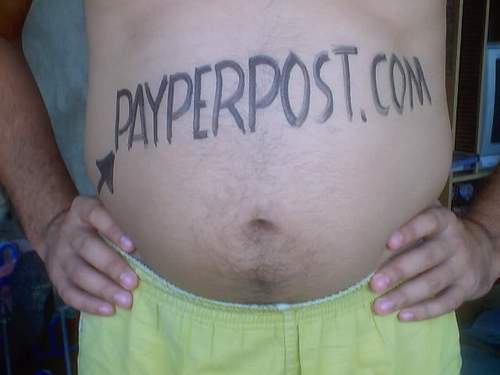
With Twisted Logic, PayPerPost CEO Defends Indefensible Business

payperpost_uroe.JPG

If you’re interested in hearing some of the most twisted, blubber-filled blather explaining and defending PayPerPost, the service that pays bloggers to write positive posts for advertisers with questionable disclosure, you’ll love this interview Jason Calacanis did with PayPerPost CEO Ted Murphy. To hear Murphy say he has no problem reading a blog that contains paid posts that aren’t disclosed as such and try to attach some kind of logic to it is one of the saddest moments in marketing history. PayPerPost has been a laughable business model from its start and to hear Murphy try to justify it is just painful and offensive. It’s an affront to what limited credibility marketing still has in the eyes of people. Lines are already blurred enough and Murphy, it seems, wants lines to disappear completely.

Murphy then goes on to categorize bloggers as people who do not have to adhere to ethics. Nothing like calling your customers idiots while using them to make money. Reacting to Calacanis noting disclosure in Google AdSense ads, Murphy tries to make the point PayPerPost posts are content and are somehow different from paid ads even though the PayPerPosts posts are paid.

The overarching problem with Murphy’s defense of his business model is that he assume people who reads blogs are just as savvy about marketing are marketers themselves. He assumes people understand all the details of marketing and can easily discern between paid and unpaid content on the web.

PayPerPost, in our opinion is, by far, the worst, most deceptive form on online advertising today. It’s worse than pop ups. It’s worse than in-text advertising. It’s worse than flogs. It’s worse than spam. Like the separation of church and state, there must be a separation between content and advertising. Payperpost ignores this and that causes great harm to an already greatly distrusted industry. Stop. Just please stop.


Picture of Steve Hall

Steve Hall

RECENT ARTICLES

TRENDING AROUND THE WEB

People who do their best work in the early morning aren’t more disciplined — for some, it’s simply the one hour before the day has had a chance to talk them out of anything

People who do their best work in the early morning aren’t more disciplined — for some, it’s simply the one hour before the day has had a chance to talk them out of anything

Global English Editing

8 things thoughtful hosts do that guests never notice but always feel

8 things thoughtful hosts do that guests never notice but always feel

Hack Spirit

9 subtle mistakes well-meaning grandparents make without realizing it

9 subtle mistakes well-meaning grandparents make without realizing it

Hack Spirit

Studies on helicopter parenting link the behavior to parents’ own fear of danger and discomfort with separation, complicating the popular idea that constant helping is simply an extension of love

Studies on helicopter parenting link the behavior to parents’ own fear of danger and discomfort with separation, complicating the popular idea that constant helping is simply an extension of love

Global English Editing

A vocabulary that keeps quietly expanding well past someone’s twenties isn’t just a love of words — it’s the one measure of intelligence psychologists have trusted for a century because it tracks so closely with how a person actually thinks

A vocabulary that keeps quietly expanding well past someone’s twenties isn’t just a love of words — it’s the one measure of intelligence psychologists have trusted for a century because it tracks so closely with how a person actually thinks

Global English Editing

An Adobe survey found 69% of workers say emoji use makes a coworker seem more likable — and the reason has more to do with replacing missing body language than making a message friendlier

An Adobe survey found 69% of workers say emoji use makes a coworker seem more likable — and the reason has more to do with replacing missing body language than making a message friendlier

Global English Editing