Visa Funds, Leverages Starving Artists For Campaign

Billboard 3.JPG

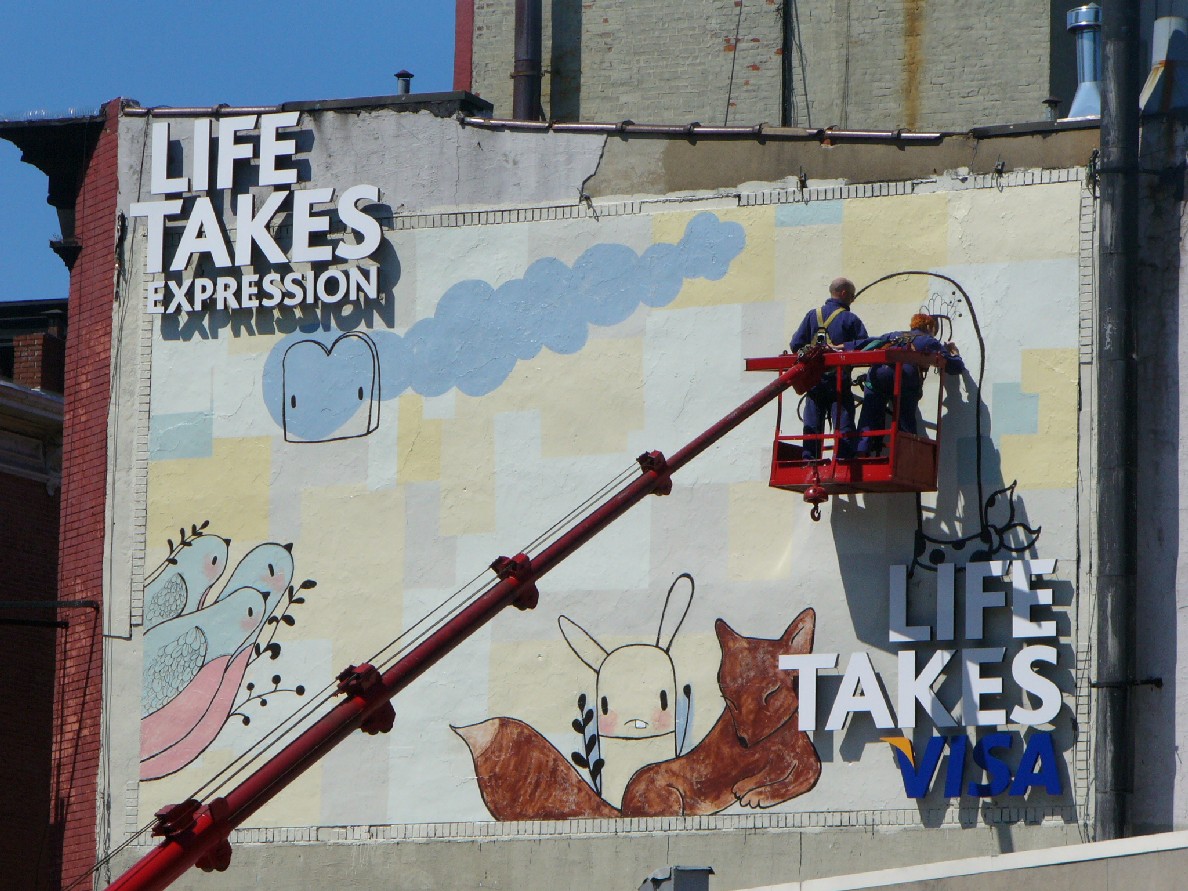
Now that Visa is in on the whole graffiti thing, graffiti artists might as well throw aways their Krylon, call it a day and move on to some new, yet to be tinged by marketers form of expression. Visa, with help from artist Trish Grantham is taking its “Life Takes Visa” to Greenwich Village in the form of of a giant wall mural with the tagline, “Life Takes Expression.” Below the mural, Visa will display other artwork in the form of sculpture, furniture, fashion and more graffiti from artists Christopher Natrop, Jeff Soto, Andy Diaz Hope, Anne Faith Nicholls, AXIS, Erik Pawassar, Parvez Taj, Ron Reihel, Christopher Cuseo, Eric Joyner, Elizabeth Paige Smith, Charlotte Ronson, Dario Antonioni and Hayley Starr.

One one hand, this is a good thing. Artists who would never have a chance for thwir work to be seen now can with the help of Visa. On the other hand, purists will see this as yet another commercialization of art. Also, if the press releases that announced this sort of thing would at least acknowledge a line is being blurred here, it might be more readily accepted but when spewed marketing babble such as this is uttered, “To engage consumers and bring our brand campaign to life, the ‘Life Takes Expression’ project provides an ideal platform to reinforce the role Visa plays in empowering consumers to express themselves,” it just makes the eyes roll back into the head. See the work here.

UPDATE: Copyranter isn’t too pleased about Visa’s use of artists to promote itself.

Picture of Steve Hall

Steve Hall

RECENT ARTICLES

TRENDING AROUND THE WEB

Psychology says the people who obsessively pack and repack their bags the night before a trip aren’t anxious — they’re processing something much older than travel

Psychology says the people who obsessively pack and repack their bags the night before a trip aren’t anxious — they’re processing something much older than travel

Global English Editing

Nobody tells you that pain doesn’t just change what you feel. It changes what you notice. After real loss, you start seeing grief in strangers’ faces at the grocery store, hearing exhaustion in your friend’s laugh, catching the micro-hesitation before someone says ‘I’m fine.’ Pain gave you a fluency you never asked for and can never unlearn

Nobody tells you that pain doesn’t just change what you feel. It changes what you notice. After real loss, you start seeing grief in strangers’ faces at the grocery store, hearing exhaustion in your friend’s laugh, catching the micro-hesitation before someone says ‘I’m fine.’ Pain gave you a fluency you never asked for and can never unlearn

Global English Editing

Most people don’t realize that the ache of loneliness isn’t actually about being alone – neuroscientists say it’s the brain’s alarm system detecting that you’re cut off from the kind of reciprocal attention humans need to regulate their nervous system

Most people don’t realize that the ache of loneliness isn’t actually about being alone – neuroscientists say it’s the brain’s alarm system detecting that you’re cut off from the kind of reciprocal attention humans need to regulate their nervous system

Global English Editing

I retired at 62 with plenty of money and a beautiful home, but I kept decorating it for guests who never came — until I realized I had built an entire life designed to impress people who weren’t actually paying attention

I retired at 62 with plenty of money and a beautiful home, but I kept decorating it for guests who never came — until I realized I had built an entire life designed to impress people who weren’t actually paying attention

Global English Editing

Psychology says people with genuinely strong self-worth don’t constantly affirm themselves — they operate through quiet patterns that most people mistake for aloofness or indifference

Psychology says people with genuinely strong self-worth don’t constantly affirm themselves — they operate through quiet patterns that most people mistake for aloofness or indifference

Global English Editing

Most people don’t realize that adults without children aren’t avoiding responsibility—they’re carrying a different kind. Research shows they become the unseen infrastructure of everyone else’s family, and that role is both chosen and completely invisible

Most people don’t realize that adults without children aren’t avoiding responsibility—they’re carrying a different kind. Research shows they become the unseen infrastructure of everyone else’s family, and that role is both chosen and completely invisible

Global English Editing