The Soap Opera Gets A New Name: Native Advertising

native_advertising_small.png

Alright, alright, alright! We give up. We’ll write about native advertising. If there’s any one thing the advertising industry is good at, it’s putting a shiny new wrapper on something that’s been around for a very long time. Take, for example, Native Advertising.

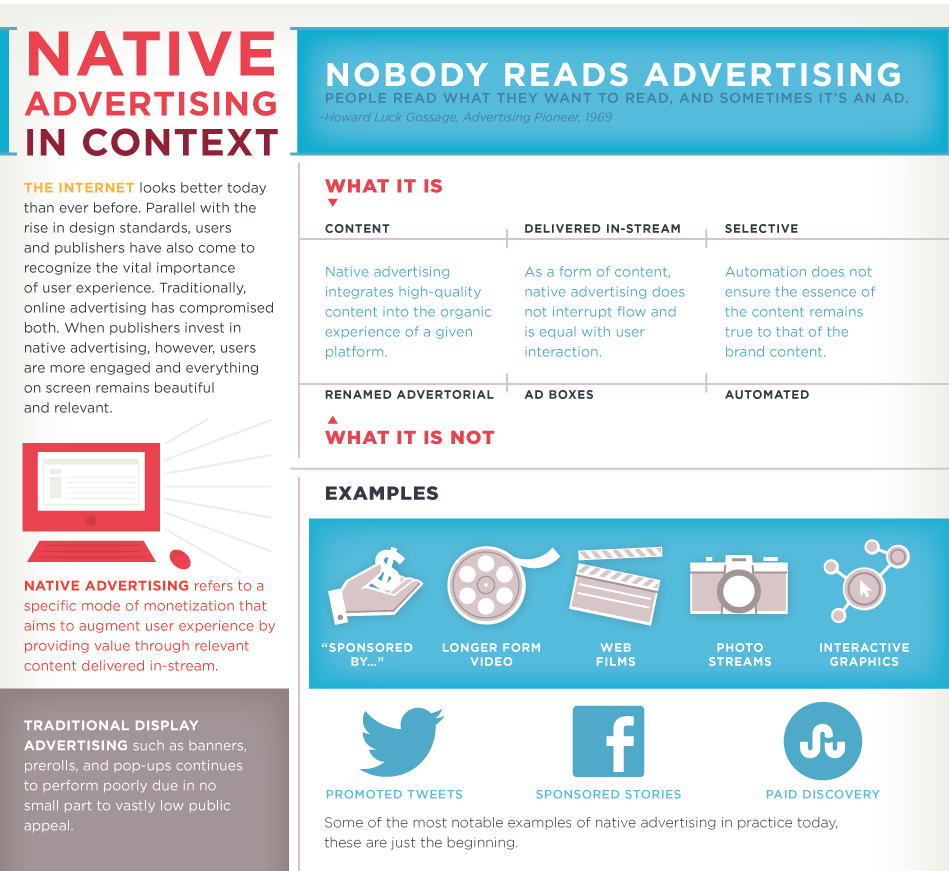
As described by digital ad firm Solve Media, “Native advertising refers to a specific mode of monetization that aims to augment user experience by providing value through relevant content delivered in-stream.”

Hmm. Remember soap operas? Relevant content created for TV (a stream, if you will) just so P&G and others could sell soap. Seriously, youngsters, that’s why soap operas were invented.

How about the Hallmark channel? Advertorials? Paid content? This site’s own AdverPost (that blue-shaded box which has appeared as the second story on pages since 2002)?

If native advertising advocates want to argue these methods of advertising aren’t in-stream, rather interruptive, we’d argue so are native ad placements. They’re an ad disguised as content placed in-stream with the rest of the news. We call that an interruption.

Yes, we get that native advertising has a bit of a different spin this time around but the purpose is the same; content created for the sole purpose of selling something. You can pretty it up any way you like but it’s still an ad.

Anyway, take a look at Solve Media’s infographic which gives an overview of native advertising, what it is, what it isn’t, how it works and how it can be used.

solve-media-native-advertising.png

Picture of Steve Hall

Steve Hall

RECENT ARTICLES

TRENDING AROUND THE WEB

7 things decisive people do differently than people who are just impulsive

7 things decisive people do differently than people who are just impulsive

Hack Spirit

8 things people who give thoughtful gifts pay attention to all year

8 things people who give thoughtful gifts pay attention to all year

Hack Spirit

Greif and Gleason’s 1980 research on how children learn politeness routines found that young children almost never say “please” or “thank you” spontaneously, they say it because a parent prompts them with “what do you say?” dozens of times a week, meaning the reflex adults later display without thinking twice was built through years of someone else’s prompting long before it became automatic.

Greif and Gleason’s 1980 research on how children learn politeness routines found that young children almost never say “please” or “thank you” spontaneously, they say it because a parent prompts them with “what do you say?” dozens of times a week, meaning the reflex adults later display without thinking twice was built through years of someone else’s prompting long before it became automatic.

Global English Editing

8 signs your in-laws see you as their own, not just someone their child married

8 signs your in-laws see you as their own, not just someone their child married

Hack Spirit

Many adult children remember watching a father work sixty-hour weeks for decades so the family could have what he never did, then watched him die in his sixties without ever prioritizing his own happiness, and now see that same pattern quietly repeating in their own lives, under a different name.

Many adult children remember watching a father work sixty-hour weeks for decades so the family could have what he never did, then watched him die in his sixties without ever prioritizing his own happiness, and now see that same pattern quietly repeating in their own lives, under a different name.

Global English Editing

Harvard researchers had 166 undergraduates rate their own pets on qualities like thoughtful, considerate and sympathetic, and the students who felt most chronically disconnected from other people scored their pets meaningfully higher on exactly those three traits, and no others.

Harvard researchers had 166 undergraduates rate their own pets on qualities like thoughtful, considerate and sympathetic, and the students who felt most chronically disconnected from other people scored their pets meaningfully higher on exactly those three traits, and no others.

Global English Editing