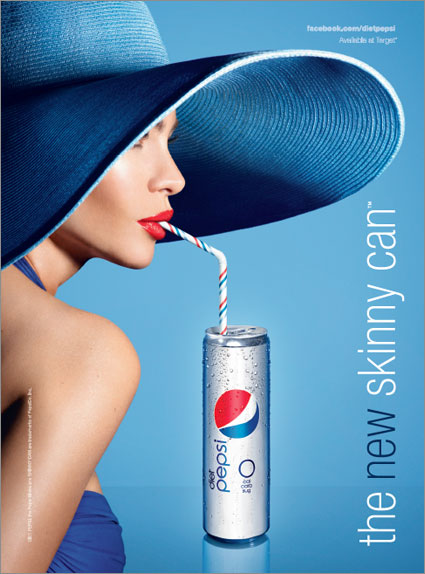
Sophia Vergara, star of Modern Family and inhabitant of a 34DD-28-39 curvaceous body, can be seen in a new ad for Diet Pepsi’s new Skinny Can, some sort of twisted ode to the fact the can of chemicals will make you skinny just because the can is skinny.
In the ad Vergara’s less that skinny upper body parts have been minimized by photographic angle and a freakish shoulder placement. Because, after all, women with big boobs aren’t skinny. They/re top heavy. And top heavy is bad when it comes to our current culture’s definition of rail thin beauty.
Some argue the ad contributes to harmful stereotypes about women’s body image. We say it’s simply the twisted notion that somehow big breasts equal slut and that no woman with big breasts could possibly be taken seriously simply because of the shape of her upper body. To that, we say utter nonsense.
Since when did people start believing the twisted notion the size of a woman’s breasts has anything remotely to do with her level of intelligence? Why does society continue to equate cavernous cleavage with idiocy? Bouncing breasts with buffoonery? Cup size as a determinent of a woman’s worth?
And why did Pepsi feel necessary to basically eliminate any hint of Vergara’s true body shape from the ad? Oh wait. Because women with big boobs are stupid and God forbid Pepsi lead us to believe stupid people drink their products.
Here’s what Pepsi CMO Jill Beraud had to say about the design. “Our slim, attractive new can is the perfect complement to today’s most stylish looks, and we’re excited to throw its coming-out party during the biggest celebration of innovative design in the world.”
Translation: Slim is in. Slim is stylish. Slim is attractive. Big boobs are out. Big boobs are unfashionable. Big boobs are ugly.
The National Eating Disorders Association has called Pepsi’s comments “thoughtless and irresponsible.”
At one point in her career, Vergara was asked to reduce her breasts a few sizes if she wanted Hollywood to take her seriously. Though she chose not to, other female actors have fallen prey to Hollywood’s definition of ideal. Christina Ricci, for example, dramatically reduced the size of her breasts years ago, presumably for the same reason; to be taken more seriously as an actor.
Our culture has created what it defines as the perfect shape for women and because of that, any woman who strays too far off the ideal is somehow deemed a bimbo, a slut, fat, flat, ugly and generally unfit for public consumption.
Even though Pepsi, in some twisted way, might possibly be congratulated for using a women whose figure is “outside the norm” in their advertising, the brand could equally be chastised for presumably choosing to minimize (read: hide) Vergara’s curvaceousness.
In closing, we will say big boobs rock and fat is phat.