Social Networks to Play Increasingly Important Role in 2012 Election

Digital_Role_in_Elections.jpg

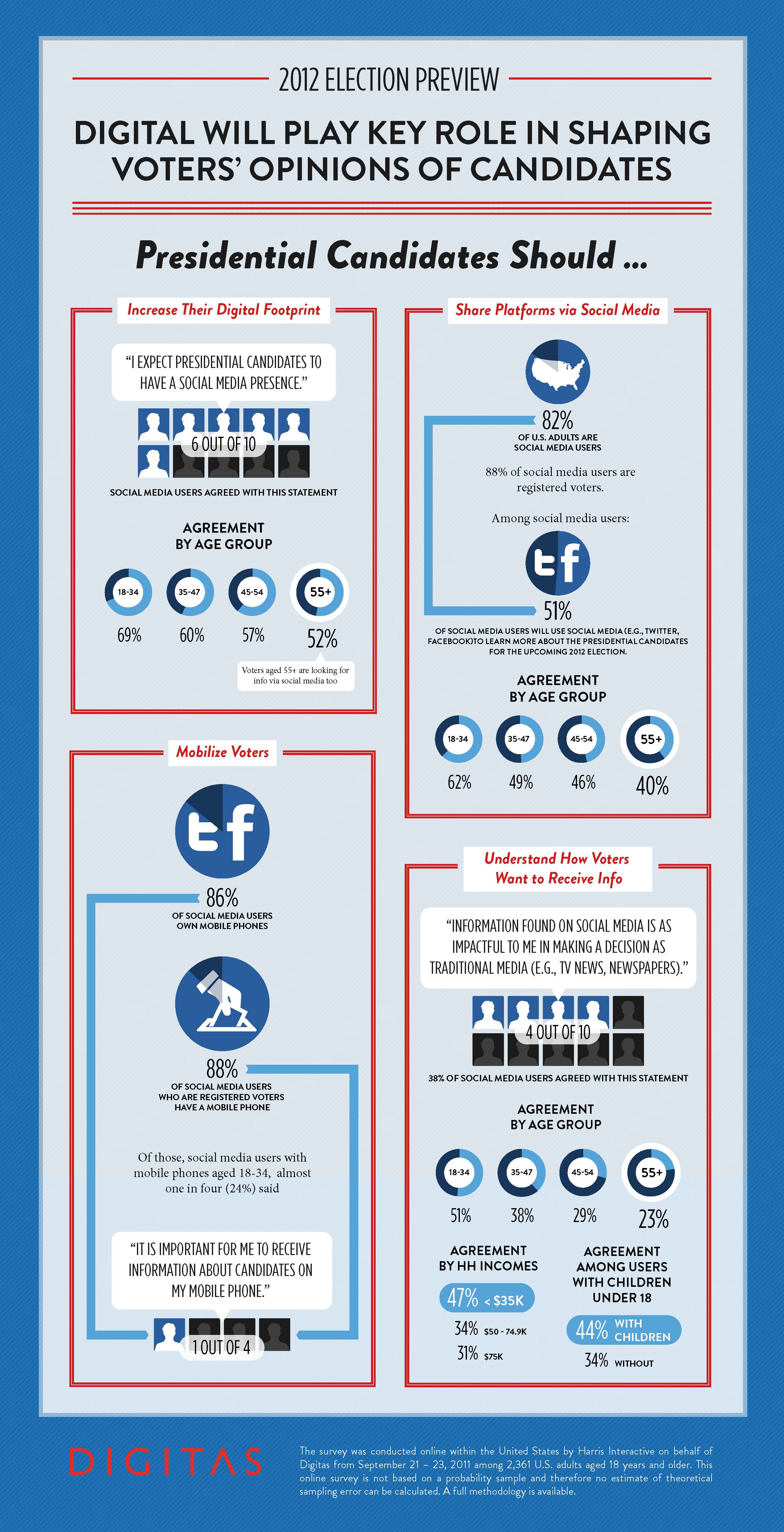
Just as it did four years ago, digital media will play an integral part in the upcoming 2012 Presidential election. A new study and infographic from Digitas finds 61 percent of social media users expect candidates to have a social media presence and 38 percent say candidate information found on social networks will influence their vote.

Unsurprisingly, younger folks (18-34) were most likely (51%) to say social networks will influence their choice of candidate.

Eighty six percent of social media users own mobile phones. Of these, 24 percent aged 18 – 34 feel it’s important to receive information about presidential candidates on their mobile phones. The study also found that 88 percent of social media users who are registered voters have mobile phones.

The survey was conducted online with the United States by Harris Interactive on behalf of Digitas from September 21 – 23, 2011 among 2,361 U.S. adults aged 18 years and older, 1,701 of whom are registered voters.


Picture of Steve Hall

Steve Hall

RECENT ARTICLES

TRENDING AROUND THE WEB

Ask a woman in her sixties what she wants to do with a free Saturday, and many go quiet, not for lack of preferences, but because decades of quietly editing their own desires to match someone else’s have left them without an easy way back to what was theirs to begin with.

Ask a woman in her sixties what she wants to do with a free Saturday, and many go quiet, not for lack of preferences, but because decades of quietly editing their own desires to match someone else’s have left them without an easy way back to what was theirs to begin with.

Global English Editing

8 habits of people who always reply, even when it would be easier not to

8 habits of people who always reply, even when it would be easier not to

Hack Spirit

Economists studying happiness data from more than 130 countries found that well-being typically bottoms out around age 47 or 48, then rises again through later adulthood — meaning the average happiness curve often improves well beyond midlife rather than continuing to decline with age.

Economists studying happiness data from more than 130 countries found that well-being typically bottoms out around age 47 or 48, then rises again through later adulthood — meaning the average happiness curve often improves well beyond midlife rather than continuing to decline with age.

Global English Editing

If you want to stop second-guessing every choice, say goodbye to these 8 habits

If you want to stop second-guessing every choice, say goodbye to these 8 habits

Hack Spirit

7 things emotionally content people no longer feel the need to prove

7 things emotionally content people no longer feel the need to prove

Hack Spirit

Psychologists at the University of Texas sent strangers to size up 177 bedrooms and offices using nothing but the objects left behind, and the tidiest, most deliberately arranged rooms almost always turned out to belong to the most conscientious person who lived or worked there.

Psychologists at the University of Texas sent strangers to size up 177 bedrooms and offices using nothing but the objects left behind, and the tidiest, most deliberately arranged rooms almost always turned out to belong to the most conscientious person who lived or worked there.

Global English Editing