Social Media Usage Levels Off Among Fortune 500

Blogging-2011-F500-1.jpg

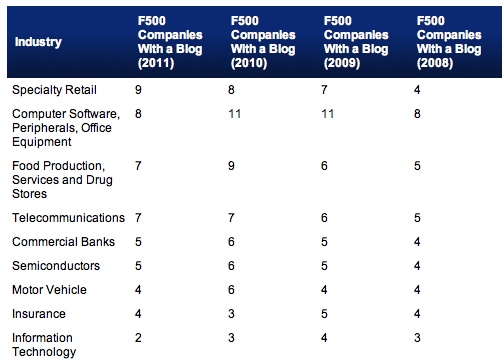
A recent study from the University of Massachusetts at Dartmouth has found the adoption of social media usage among Fortune 500 companies has leveled off. Across multiple industries, usage of Twitter, Facebook and blogs in 2011 is level with or below that of 2010.

In 2010, 23 percent of Fortune 500 companies had a blog. In 2011, that figured remained unchanged at 23 percent. In 2010, 60 percent of Fortune 500 companies have a Twitter account. In 2011, 62 percent have an account. In 2010, 56 percent of Fortune 500 companies had a Facebook account. In 2011, 58 percent have an account.

As Marketing Pilgrim notes, often times larger corporations adopt a wait and see attitude towards new methods or marketing opting, instead, to watch what smaller, more nimble corporations do. The larger companies then learn, fix and improve.

Also of note, the shine is off the new object. Social media isn’t new any longer. It’s gone well past the experimental stage and now it, like everything else in marketing, is expected to contribute to a company’s bottom line. And if it’s not doing so, it’s more than likely to be scrubbed.

Over the course of the four years the study has been conducted, Fortune 500 companies always lagged behind Inc. 500 companies, charities and higher education, the other three areas this study examines. Perhaps it’s just the inherent red tape that comes with large companies. Or the need for everything to be checked, double checked and approved seven times over. Neither of which sits well with social media’s need to be in the moment, conversational and devoid of anything closely resembling red tape.

Like a slow moving ship attempting to miss an iceberg, it just takes some companies longer than others to shift cultural and operational rudders.

Facebook-F500-2011.jpg

Twitter-Accounts-F500.jpg

Blogging-2011-F500.jpg

Picture of Steve Hall

Steve Hall

RECENT ARTICLES

TRENDING AROUND THE WEB

Psychology says the reason some people become unapologetically themselves after 50 isn’t arrogance — it’s that they’ve finally stopped outsourcing their self-worth to people who were never paying attention in the first place

Psychology says the reason some people become unapologetically themselves after 50 isn’t arrogance — it’s that they’ve finally stopped outsourcing their self-worth to people who were never paying attention in the first place

Global English Editing

Psychology says gen z’s obsession with clean eating isn’t really about food. It’s the first generation that inherited a world of ambient health anxiety and unlimited conflicting information, and controlling their plate became the only form of control that felt achievable.

Psychology says gen z’s obsession with clean eating isn’t really about food. It’s the first generation that inherited a world of ambient health anxiety and unlimited conflicting information, and controlling their plate became the only form of control that felt achievable.

Global English Editing

The people who genuinely thrive in retirement don’t have more money, more hobbies, or more free time. They have five habits that most people only discover by accident — If they discover them at all

The people who genuinely thrive in retirement don’t have more money, more hobbies, or more free time. They have five habits that most people only discover by accident — If they discover them at all

Global English Editing

Psychology says the most painful friendships to lose aren’t the ones that exploded, they’re the ones where you slowly realized you were the only person maintaining the illusion that it was mutual, and the grief isn’t about losing them — it’s about finally admitting you never had what you thought you did

Psychology says the most painful friendships to lose aren’t the ones that exploded, they’re the ones where you slowly realized you were the only person maintaining the illusion that it was mutual, and the grief isn’t about losing them — it’s about finally admitting you never had what you thought you did

Global English Editing

Psychologists explain that the reason your dog sleeping in your bed feels more comforting than sleeping next to another person is that the dog offers presence without evaluation, warmth without negotiation, and loyalty that never requires you to perform a version of yourself

Psychologists explain that the reason your dog sleeping in your bed feels more comforting than sleeping next to another person is that the dog offers presence without evaluation, warmth without negotiation, and loyalty that never requires you to perform a version of yourself

Global English Editing

Psychology says people raised in the era of “children should be seen and not heard” didn’t stop having feelings, they became world-class architects of internal storage systems, and the quiet crisis of their 60s and 70s is that the storage is full and the building was never designed with an exit

Psychology says people raised in the era of “children should be seen and not heard” didn’t stop having feelings, they became world-class architects of internal storage systems, and the quiet crisis of their 60s and 70s is that the storage is full and the building was never designed with an exit

Global English Editing