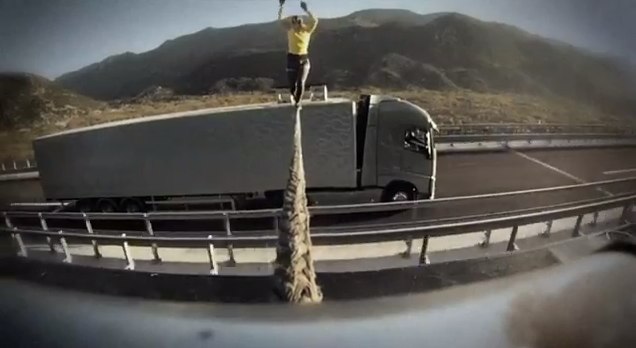
Slackliner Tightropes Between Two Speeding Volvo Trucks

volvo_trucks_slackliner.jpg

We have to agree with AdWeek’s David Gianatasio on this one. To “demonstrate the precision and control of the new Volvo FH series truck,” Swedish ad agency Forsman & Bodenfors set up a slacklining stunt whereby slickliner Faith Dickey would walk a tightrope between two moving trucks approaching tunnels.

As with other stunts similar to this that attempt to illustrate the superiority of a machine or vehicle, as Gianatasio argues, it’s really the skill of the operator as opposed to the technical precision of the machine that truly matters. Volvo could have grabbed two 20 year old 18 wheelers, a pair of great stunt drivers and accomplished the same thing.

Sure, this stunt is fun to watch but does it really demonstrate the capability of the vehicle? We’d buy into this more if Volvo had hired two overweight, beer gut-sporting slobs who’d just each downed a six pack and put them behind the wheel of a vehicle that actually could maneuver itself through the use of a sophisticated computer-aided guidance system.

Of course we take nothing away from Dickey’s accomplishment here. As she says in the video, she’s done a lot of slacklining but never before between two moving trucks. SO there’s that.

YouTube video

Picture of Steve Hall

Steve Hall

RECENT ARTICLES

TRENDING AROUND THE WEB

7 things people who hit snooze five times a morning have in common

7 things people who hit snooze five times a morning have in common

Hack Spirit

7 things people who work with their hands understand that office workers rarely do

7 things people who work with their hands understand that office workers rarely do

Hack Spirit

7 things decisive people do differently than people who are just impulsive

7 things decisive people do differently than people who are just impulsive

Hack Spirit

8 things people who give thoughtful gifts pay attention to all year

8 things people who give thoughtful gifts pay attention to all year

Hack Spirit

Greif and Gleason’s 1980 research on how children learn politeness routines found that young children almost never say “please” or “thank you” spontaneously, they say it because a parent prompts them with “what do you say?” dozens of times a week, meaning the reflex adults later display without thinking twice was built through years of someone else’s prompting long before it became automatic.

Greif and Gleason’s 1980 research on how children learn politeness routines found that young children almost never say “please” or “thank you” spontaneously, they say it because a parent prompts them with “what do you say?” dozens of times a week, meaning the reflex adults later display without thinking twice was built through years of someone else’s prompting long before it became automatic.

Global English Editing

8 signs your in-laws see you as their own, not just someone their child married

8 signs your in-laws see you as their own, not just someone their child married

Hack Spirit