RTCRM Wrings Sweat Out of Agency Creatives

rtc-sweatshop.jpg

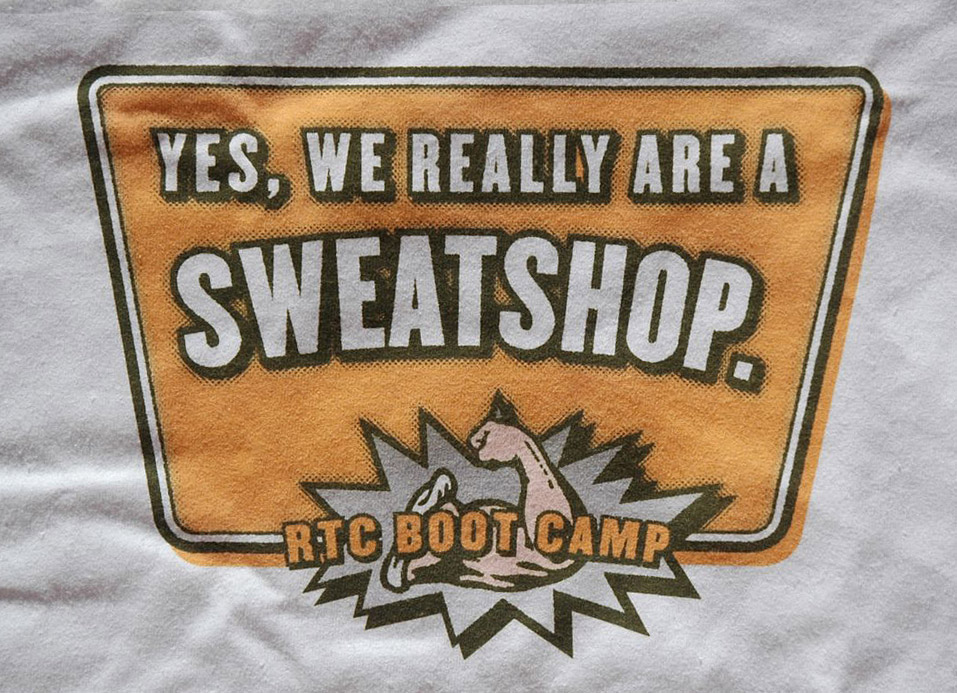
Creatives hitting the vending machines at RTCRM might be accosted with a smorgasbord of aluminum signs, each with a military-style message demanding, in some short shouty way, that they beat their own bodies into a pulp and do a great deal of sweating.

This is part of RTCRM’s six-week “extreme exercise” boot camp. Creatives meet at 7am, twice a week, to groan and sweat with fellow languid-limbed chums.

Must be interesting for morale. You never quite look at someone the same way once you’ve seen where their sweat glands are most active. And an approach like this is infinitely kinder than firing people for smoking.

Employees that finish boot camp get to — wait for it! — vote for the best T-shirt concept. Ooh. Aah. Here’s some, sporting tees and doing one-armed push-ups. And here’s all the signage (and, in some cases, shirtage):

o Advertising Stinks
o The Ass You Kick May Be Your Own
o We’ve Got the Biggest Guns in Advertising
o Pass Out on K Street and Feel Good About It
o Like Gym Class Without the Wedgies

Boy. I can smell the sour, damp cotton from here.

Picture of Steve Hall

Steve Hall

RECENT ARTICLES

TRENDING AROUND THE WEB

Nobody talks about the women who are sixty-five and childless not by choice but by circumstance — not because the moment never came but because it came at the wrong time with the wrong person three separate times and now the silence in their house isn’t peaceful, it’s the sound of a question that answered itself while they were still deciding

Nobody talks about the women who are sixty-five and childless not by choice but by circumstance — not because the moment never came but because it came at the wrong time with the wrong person three separate times and now the silence in their house isn’t peaceful, it’s the sound of a question that answered itself while they were still deciding

Global English Editing

Research suggests boomers who grew up in working-class homes during the 1950s and 60s developed these 8 toughness traits that most people today couldn’t survive with — and it explains why they can’t understand why younger generations ‘give up so easily’

Research suggests boomers who grew up in working-class homes during the 1950s and 60s developed these 8 toughness traits that most people today couldn’t survive with — and it explains why they can’t understand why younger generations ‘give up so easily’

Global English Editing

Adults who were praised exclusively for being ‘good’ as children often become people who have no idea how to want things for themselves because desire was never part of the identity they were rewarded for

Adults who were praised exclusively for being ‘good’ as children often become people who have no idea how to want things for themselves because desire was never part of the identity they were rewarded for

Global English Editing

Psychology says people who won’t travel because they can’t leave their dog, or who turn down social invitations to stay home with their pet, aren’t isolated — they’re prioritizing the one relationship in their life that never makes them feel like a burden

Psychology says people who won’t travel because they can’t leave their dog, or who turn down social invitations to stay home with their pet, aren’t isolated — they’re prioritizing the one relationship in their life that never makes them feel like a burden

Global English Editing

I’m 65 and my father died in 1996 without ever once telling me what scared him and I’ve spent twenty-nine years collecting the questions I would have asked if I’d known men from his generation needed permission to be something other than strong

I’m 65 and my father died in 1996 without ever once telling me what scared him and I’ve spent twenty-nine years collecting the questions I would have asked if I’d known men from his generation needed permission to be something other than strong

Global English Editing

There’s a specific kind of loneliness that belongs to people who never had children. It doesn’t arrive as sadness. It arrives as irrelevance, the growing suspicion that the future is a conversation happening in another room that you were never invited into.

There’s a specific kind of loneliness that belongs to people who never had children. It doesn’t arrive as sadness. It arrives as irrelevance, the growing suspicion that the future is a conversation happening in another room that you were never invited into.

Global English Editing