RSS Ads Done Incorrectly Annoy Readers

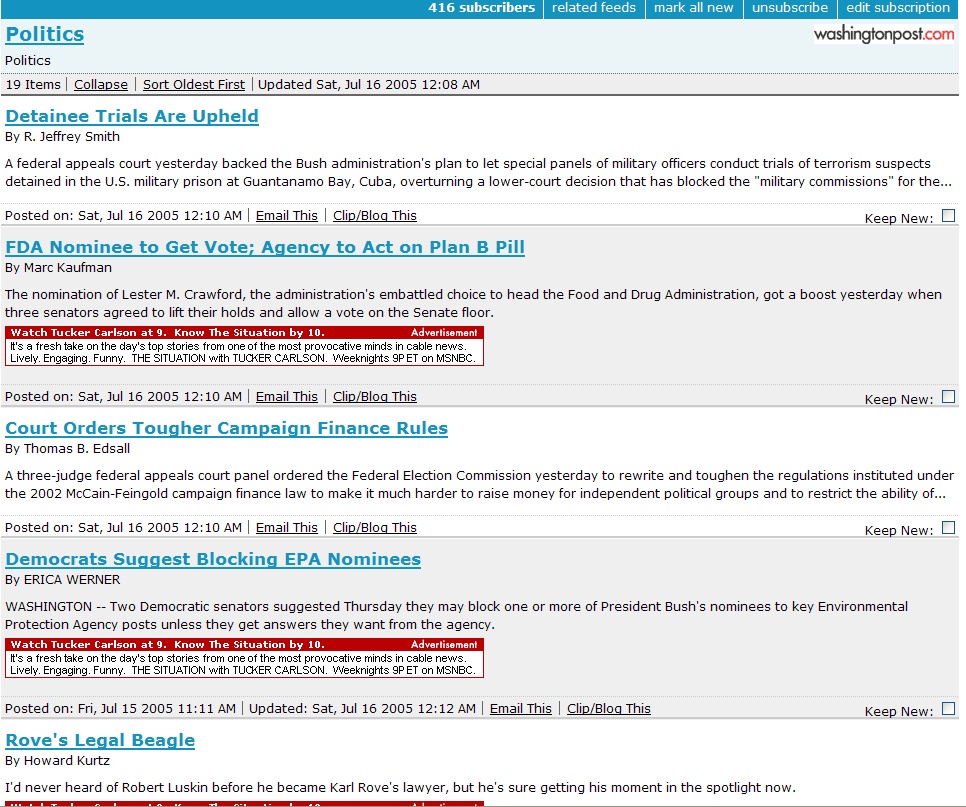
rss_feed_ads.jpg

Where’s there’s smoke, there’s fire goes the old saying which might be appropo to this Flickr user’s complaint regarding the proliferation of ads in RSS feeds. adammathes writes, “I have no problem with advertising, but this is just ridiculous. A one-to-one ratio of ads and content in an RSS feed? Do they even bother to show this sort of thing to actual users before doing it?”

One might argue it’s simply the fairly standard 50/50 ad/edit ratio but in reality, it just makes for a crowded reading experience. While this feed from the Washington Post appears to have an ad in every other RSS item, some publisher place one in every item. While we can’t state categorically that Adrants will never have ads in its RSS feed, we can say, for sure, the ratio will be far more acceptable along the lines of one ad per ten items or so.

Our viewpoint is that ads in RSS feeds that contain the entire article, readable without having to link back to the originating website, is a better method of RSS advertising than ads placed within abbreviated RSS feeds which require the reader to link back to the originating site to read the entire article. The first method hits up the reader with one ad. The second slaps them in the face with two assuming the originating site serves ads as well. While we’re spouting viewpoints, individual items within an RSS feed that are standalone ads (not part of a content/article item) are annoying and pointless. Either the preceding “ADV” or the headlines themselves scream “I’m ad ad! Ignore me!” Ads that are part of a feed item are far more acceptable and more likely to be seen and acted upon. OK. We’re off the soapbox now. Carry on.


Picture of Steve Hall

Steve Hall

RECENT ARTICLES

TRENDING AROUND THE WEB

People who secretly see you as competition usually display these 7 behaviors

People who secretly see you as competition usually display these 7 behaviors

Hack Spirit

In the original precrastination experiments, people picked up whichever bucket was closer and carried it the rest of the way — even when it meant carrying more total weight for longer — just to stop holding the choice open

In the original precrastination experiments, people picked up whichever bucket was closer and carried it the rest of the way — even when it meant carrying more total weight for longer — just to stop holding the choice open

Global English Editing

If someone is only pretending to like you, these 8 behaviors usually give them away

If someone is only pretending to like you, these 8 behaviors usually give them away

Hack Spirit

7 things people quietly outgrow once they become comfortable with who they are

7 things people quietly outgrow once they become comfortable with who they are

Hack Spirit

Cornell researcher Vanessa Bohns has spent years studying why people agree to requests they’d rather decline, and her research consistently finds that people dramatically overestimate the social cost of saying no, which means most of the exhaustion of over-committing gets paid for a consequence that was never really on the table

Cornell researcher Vanessa Bohns has spent years studying why people agree to requests they’d rather decline, and her research consistently finds that people dramatically overestimate the social cost of saying no, which means most of the exhaustion of over-committing gets paid for a consequence that was never really on the table

Global English Editing

If you want a quieter mind as you get older, say goodbye to these 8 daily habits

If you want a quieter mind as you get older, say goodbye to these 8 daily habits

Hack Spirit