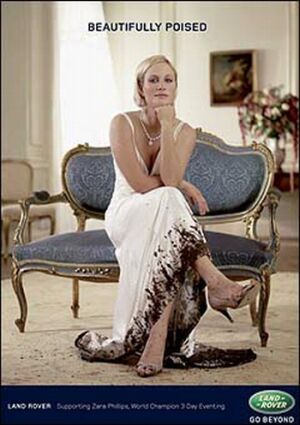
Queen Elizabeth’s Granddaughter Appears in Land Rover Ad

zara-philips_25.jpg

Oh the horror! AdPunch points to recent news Zara Phillips, the granddaughter of Queen Elizabeth II, has appeared in a Land Rover ad wearing a white gown covered in mud with the headline, “Beautifully Poised.” Nice ad but it’s apparently against royal protocol. Her appearance is part of sponsorship deal with Land Rover which sponsored her during her recent competition in the World Equestrian Games where she won a gold.

While the Queen might be angry, many other are just fine with her land Rover appearance. Labour Glascow East MP Ian Davison said, “Miss Phillips is to be commended for making her own way in the world. If she is cashing in on her success as a sporting star as other people do, then she is making something of herself.”

Is this the end of royalty as we know it? Or is this just the natural way of things? Those in the U.K., please enlighten us.


Picture of Steve Hall

Steve Hall

RECENT ARTICLES

TRENDING AROUND THE WEB

7 things people who hit snooze five times a morning have in common

7 things people who hit snooze five times a morning have in common

Hack Spirit

7 things people who work with their hands understand that office workers rarely do

7 things people who work with their hands understand that office workers rarely do

Hack Spirit

7 things decisive people do differently than people who are just impulsive

7 things decisive people do differently than people who are just impulsive

Hack Spirit

8 things people who give thoughtful gifts pay attention to all year

8 things people who give thoughtful gifts pay attention to all year

Hack Spirit

Greif and Gleason’s 1980 research on how children learn politeness routines found that young children almost never say “please” or “thank you” spontaneously, they say it because a parent prompts them with “what do you say?” dozens of times a week, meaning the reflex adults later display without thinking twice was built through years of someone else’s prompting long before it became automatic.

Greif and Gleason’s 1980 research on how children learn politeness routines found that young children almost never say “please” or “thank you” spontaneously, they say it because a parent prompts them with “what do you say?” dozens of times a week, meaning the reflex adults later display without thinking twice was built through years of someone else’s prompting long before it became automatic.

Global English Editing

8 signs your in-laws see you as their own, not just someone their child married

8 signs your in-laws see you as their own, not just someone their child married

Hack Spirit