Online Ad Spend to Surpass Print in 2012

emarketer_print_online_ad_spend.gif

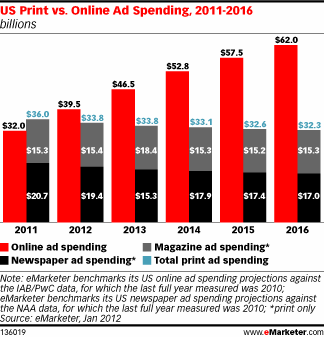
This is big. A new forecast from eMarketer states online spend will pass print for first time in 2012. US online advertising spending, which grew 23% to $32.03 billion in 2011, is expected to grow an additional 23.3% to $39.5 billion this year pushing it ahead of total spending on print newspapers and magazines, according to the report. Print advertising spending is expected to fall to $33.8 billion in 2012 from $36 billion in 2011.

eMarketer’s previous US online advertising forecast from July 2011 forecasted 20.2% growth to $31.1 billion in 2011. Stronger than expected results from major industry players and the IAB/PwC benchmark through the first three quarters of 2011 contributed to the upward revision.

Despite concerns about the troubled economy among agencies and marketers, total ad spending in the US is expected to rebound in 2012 after rising 3.4% to $158.9 billion in 2011. eMarketer predicts US total media ad spend will grow an estimated 6.7% to $169.48 in 2012, boosted, they say, by the national elections and summer Olympics in London.

Spending on TV advertising grew 2.8% in 2011 to $60.7 billion. This year, eMarketer says TV ad spending will grow an estimated 6.8% to $64.8 billion.

eMarketer also estimated US digital newspaper ad revenues grew 8.3% to $3.3 billion in 2011. Print advertising revenues at newspapers fell 9.3% to $20.7 billion in 2011. At magazines, US print ad revenues are expected to rise 0.5% to $15.34 billion in 2012, up from $15.3 billion last year. US digital advertising spending at magazines grew 18.8% to $2.7 billion in 2011.


Picture of Steve Hall

Steve Hall

RECENT ARTICLES

TRENDING AROUND THE WEB

A vocabulary that keeps quietly expanding well past someone’s twenties isn’t just a love of words — it’s the one measure of intelligence psychologists have trusted for a century because it tracks so closely with how a person actually thinks

A vocabulary that keeps quietly expanding well past someone’s twenties isn’t just a love of words — it’s the one measure of intelligence psychologists have trusted for a century because it tracks so closely with how a person actually thinks

Global English Editing

An Adobe survey found 69% of workers say emoji use makes a coworker seem more likable — and the reason has more to do with replacing missing body language than making a message friendlier

An Adobe survey found 69% of workers say emoji use makes a coworker seem more likable — and the reason has more to do with replacing missing body language than making a message friendlier

Global English Editing

A boundary delivered without an explanation usually isn’t coldness — it’s someone who’s learned that the explanation is exactly what invites the negotiation they were trying to avoid

A boundary delivered without an explanation usually isn’t coldness — it’s someone who’s learned that the explanation is exactly what invites the negotiation they were trying to avoid

Global English Editing

Someone who lets a frazzled stranger go ahead of them in line isn’t necessarily being generous — they’re picking up on small shifts in tone and posture that most people only catch when told to look for them

Someone who lets a frazzled stranger go ahead of them in line isn’t necessarily being generous — they’re picking up on small shifts in tone and posture that most people only catch when told to look for them

Global English Editing

The difference between the words you recognize and the words you actually use — and what that gap says about how you learned them

The difference between the words you recognize and the words you actually use — and what that gap says about how you learned them

Global English Editing

Keeping the counter clear while cooking is partly a private habit and partly a quiet form of consideration — a way of leaving the kitchen usable for whoever moves through it next, without needing to say so out loud

Keeping the counter clear while cooking is partly a private habit and partly a quiet form of consideration — a way of leaving the kitchen usable for whoever moves through it next, without needing to say so out loud

Global English Editing