
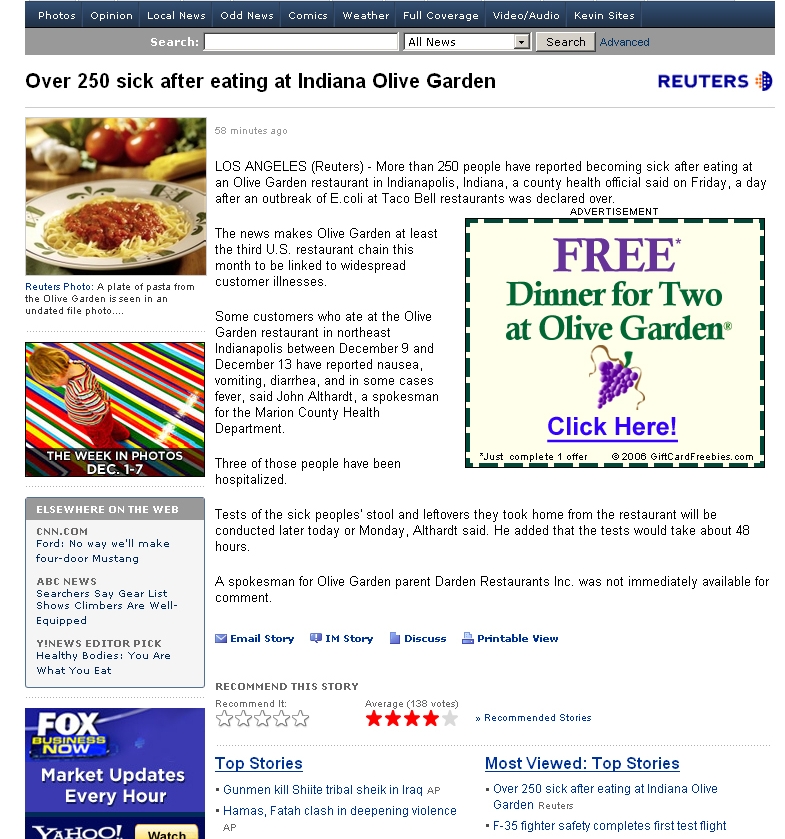
Olive Garden Makes 250 Puke Then Offers Free Chance to Puke

olive_garden_contextual.jpg

That nasty sickness contextual advertising just can seem to shake has reared its ugly head once again. This time, those reading about how 250 people got sick after eating at an Indianapolis Olive Garden restaurant are now encouraged to experience their own sickness first hand compliments of a Free Dinner for Two at the national restaurant chain. Oh yes, Olive Garden wouldn’t think of making you pay to get sick at one of their restaurants. They want you to get sick for free. How thoughtful.


Picture of Steve Hall

Steve Hall

RECENT ARTICLES

TRENDING AROUND THE WEB

8 things parents say that make adult children feel closer to them

8 things parents say that make adult children feel closer to them

Hack Spirit

People who secretly see you as competition usually display these 7 behaviors

People who secretly see you as competition usually display these 7 behaviors

Hack Spirit

In the original precrastination experiments, people picked up whichever bucket was closer and carried it the rest of the way — even when it meant carrying more total weight for longer — just to stop holding the choice open

In the original precrastination experiments, people picked up whichever bucket was closer and carried it the rest of the way — even when it meant carrying more total weight for longer — just to stop holding the choice open

Global English Editing

If someone is only pretending to like you, these 8 behaviors usually give them away

If someone is only pretending to like you, these 8 behaviors usually give them away

Hack Spirit

7 things people quietly outgrow once they become comfortable with who they are

7 things people quietly outgrow once they become comfortable with who they are

Hack Spirit

Cornell researcher Vanessa Bohns has spent years studying why people agree to requests they’d rather decline, and her research consistently finds that people dramatically overestimate the social cost of saying no, which means most of the exhaustion of over-committing gets paid for a consequence that was never really on the table

Cornell researcher Vanessa Bohns has spent years studying why people agree to requests they’d rather decline, and her research consistently finds that people dramatically overestimate the social cost of saying no, which means most of the exhaustion of over-committing gets paid for a consequence that was never really on the table

Global English Editing










