Now You Don’t Have to Wonder What the Mirror Thinks

interactive-mirrors-marketing.jpg

I can’t help thinking Snow White’s childhood would have been less tragic if her evil stepmother was fed marketing propaganda, and not beauty validation, from her enchanted mirror:

“Mirror mirror, who’s the fairest?”

“You’re very close! Here’s a projection of what La Mer can do about those unsightly crow’s feet.”

If, like other emotionally unavailable moms, she spent all her free time working on herself, she would probably never have gotten hip to the “fact” Snow White was — le gasp! — prettier than she was.

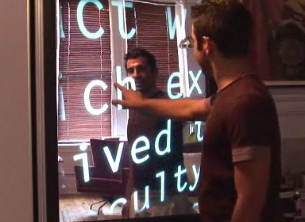
I’m thinking these thoughts because Alpay Kasal and Interference Inc. created something called the Interactive Mirror, which lets people “draw” across reflective surfaces or interact with stuff that’s already there (like ads!).

See a demo. I like it when the girl runs her finger down the mirror and flowers bloom along the trail. Oh, it’s also neat when the guy customizes a shirt. The photo-viewing feature is cool too.

This is pretty nifty all around, actually. I can imagine it seeing it in “ambiance” stores like Virgin.


Picture of Steve Hall

Steve Hall

RECENT ARTICLES

TRENDING AROUND THE WEB

I spent years going to every event I was invited to and smiling through every surface-level conversation because I believed that wanting to be alone instead was a character flaw I needed to correct — and then one day I stopped going and discovered that the life I’d been treating as a consolation prize was actually the one I wanted

I spent years going to every event I was invited to and smiling through every surface-level conversation because I believed that wanting to be alone instead was a character flaw I needed to correct — and then one day I stopped going and discovered that the life I’d been treating as a consolation prize was actually the one I wanted

Global English Editing

I watched my best friend’s mind go quietly dim in her mid-60s and my own stay sharp into my 70s — and the difference between us was not genetics or luck but the fact that she retired from everything the day she retired from work, and I never fully understood until then that the mind takes its instructions from the life and not the other way around

I watched my best friend’s mind go quietly dim in her mid-60s and my own stay sharp into my 70s — and the difference between us was not genetics or luck but the fact that she retired from everything the day she retired from work, and I never fully understood until then that the mind takes its instructions from the life and not the other way around

Global English Editing

Psychology says the relationship between an elderly parent and the one adult child who does everything is one of the most psychologically complex dynamics in any family — and the resentment that builds in silence is almost always mutual

Psychology says the relationship between an elderly parent and the one adult child who does everything is one of the most psychologically complex dynamics in any family — and the resentment that builds in silence is almost always mutual

Global English Editing

Psychology says people who constantly set goals but never start them aren’t procrastinating – they’re protecting themselves from the possibility that trying their best might not be enough

Psychology says people who constantly set goals but never start them aren’t procrastinating – they’re protecting themselves from the possibility that trying their best might not be enough

Global English Editing

Psychology says people who cannot tolerate silence, solitude, or an unoccupied evening aren’t extroverts — they’re people for whom stillness has become dangerous, because stillness is the condition under which the things they have been outrunning are most likely to catch up

Psychology says people who cannot tolerate silence, solitude, or an unoccupied evening aren’t extroverts — they’re people for whom stillness has become dangerous, because stillness is the condition under which the things they have been outrunning are most likely to catch up

Global English Editing

Psychology says the reason some people can recognize a face from twenty years ago but forget a name from twenty minutes ago isn’t a memory problem — it’s an architecture problem, and the architecture was built this way long before you had any say in it

Psychology says the reason some people can recognize a face from twenty years ago but forget a name from twenty minutes ago isn’t a memory problem — it’s an architecture problem, and the architecture was built this way long before you had any say in it

Global English Editing