Non-Voice Mobile Usage up 51.9% to 82 Minutes Per Day

emarketer_time_spent.gif

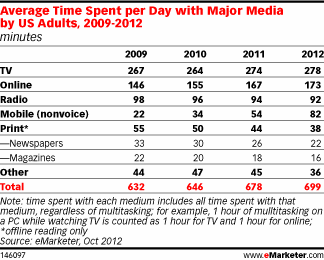
A recent report from eMarketer has pegged non-voice mobile usage at 82 minutes per day for 2012, an increase of 51.9 percent over 2011’s 34 minutes per day. This growth is in contrast to slowing time spent online with non-mobile internet connected devices. This year, eMarketer estimates time spent online will grow just 3.6% to an average 173 minutes per day, compared to 7.7% growth in 2011 to 167 minutes per day.

Sadly, marketers’ adoption of mobile as an advertising platform hasn’t kept pace with its growth. While mobile is expected to account for 11.7 percent of time spent online, its share of ad spend will hit just 1.6 percent.

While mobile advertising is expected to grow rapidly in the next few years – eMarketer estimated in September that overall US mobile advertising spending will reach $2.61 billion this year before rising to nearly $12 billion in 2016 – there are some significant barriers that both marketers and ad publishers will have to overcome before the mobile ad spending will achieve parity with the share of time spent by consumers on mobile devices.

In the case of search advertising, for example, the lower likelihood of consumers making purchases on mobile devices – which is reflected by the small footprint that mobile commerce holds in the overall ecommerce market – has forced companies like Google to charge lower rates for mobile search ads.

In the case of display advertising, small screen sizes have limited the ability of display ad publishers like Facebook to serve as many impressions per page view as they might to desktop users.

Despite continued concerns about cord-cutting, time spent watching television continues to increase – growing to an average 278 minutes per day in 2012, up from 274 minutes in 2011 – though TV’s share of the total pie will decrease marginally, by less than 1 percentage point, over the same period.

The largest shift downward continues to come from the print media sector. Time spent with print media will drop to an average 38 minutes per day this year, eMarketer estimates, down from an average 44 minutes per day in 2011. Newspapers will see a drop to an average 22 minutes per day this year, while time spent with print magazines will fall to 16 minutes per day.


Picture of Steve Hall

Steve Hall

RECENT ARTICLES

TRENDING AROUND THE WEB

Psychology says that the person who remembers every small detail about you, your coffee order, your dog’s name, your mother’s surgery date, isn’t just thoughtful. They grew up in an environment where noticing details was a survival skill, and tenderness became the least painful use for it

Psychology says that the person who remembers every small detail about you, your coffee order, your dog’s name, your mother’s surgery date, isn’t just thoughtful. They grew up in an environment where noticing details was a survival skill, and tenderness became the least painful use for it

Global English Editing

I’m 66 and I spent two decades working myself to the bone so my family would never go without. The hardest thing to admit was that I used work as a place to hide from the family I was supposedly doing it all for

I’m 66 and I spent two decades working myself to the bone so my family would never go without. The hardest thing to admit was that I used work as a place to hide from the family I was supposedly doing it all for

Global English Editing

I’m 65 and I’ve watched three marriages in my friend group fall apart in retirement — and the pattern isn’t infidelity or money, it’s that these men spent forty years being providers and never learned how to actually be present with another human being

I’m 65 and I’ve watched three marriages in my friend group fall apart in retirement — and the pattern isn’t infidelity or money, it’s that these men spent forty years being providers and never learned how to actually be present with another human being

Global English Editing

I’m 44 and I just realized that the reason I call my mother every Sunday isn’t love — it’s that when I was nine she once said “you’re the only one who checks on me” and I’ve been carrying that assignment for thirty-five years without ever asking to be relieved

I’m 44 and I just realized that the reason I call my mother every Sunday isn’t love — it’s that when I was nine she once said “you’re the only one who checks on me” and I’ve been carrying that assignment for thirty-five years without ever asking to be relieved

Global English Editing

Psychology says people with very strong personalities aren’t less empathetic than others — they simply extend empathy to people’s actual circumstances rather than to their preferred narratives about those circumstances

Psychology says people with very strong personalities aren’t less empathetic than others — they simply extend empathy to people’s actual circumstances rather than to their preferred narratives about those circumstances

Global English Editing

Psychology says people who repeatedly attract emotionally unavailable partners aren’t unlucky. They’re fluent in a specific emotional dialect learned in childhood where love always required decoding, and available people feel foreign because clarity was never part of the original language

Psychology says people who repeatedly attract emotionally unavailable partners aren’t unlucky. They’re fluent in a specific emotional dialect learned in childhood where love always required decoding, and available people feel foreign because clarity was never part of the original language

Global English Editing