
Mobile Ad Spend to Hit $6.4 Billion in 2012

emarketer_us_mobile_spend.jpg

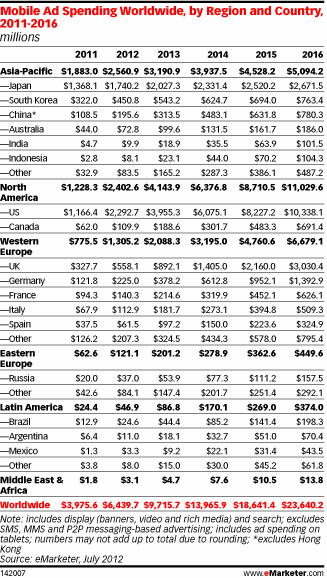
A new report from eMarketer pegs global mobile spending at $6.43 for 2012. US mobile ad spend will hit $2.29 billion, up 96.6 percent from $1.16 billion in 2011. Until this year, Japan was the leader in mobile ad spend with $1.36 billion in 2011. While mobile is more mature in Japan, eMarketer estimates Japan will see a 27.2 percent increase in spending to $1.74 billion in 2012.

Asia-Pacific is still a strong mobile advertising market, particularly in South Korea and Japan, keeping it far ahead of Europe in mobile spending. Mobile ad spending in Asia-Pacific will reach $2.56 billion in 2012, according to eMarketer, while mobile advertising spending in Western Europe and Eastern Europe will reach $1.3 billion and $121.1 million, respectively, this year.

Additional findings:

– Spending on mobile advertising in the US will top all other regions in the world for the first time in 2012.

– Global mobile ad spending will reach $6.43 billion in 2012, yet account for just 1% of total ad spending worldwide.

– The mobile advertising market in Asia-Pacific remains far bigger than in Europe.

– Mobile advertising, though just 2.3% of total ad spending in the UK, is expected to take a record share by 2016, reaching 11% of total ad spending there.

– China is set to become the world’s second-largest advertising market in 2013, and the second-largest digital advertising market the following year, behind the US.

– The strength of ad spending in Asia-Pacific, combined with the Olympics, will help buoy total ad spending growth to 7.4% in 2012, despite economic concerns in Europe.

– Digital advertising, as expected, will take a record 20% share of total ad spending this year worldwide. eMarketer estimates online ad spend worldwide will reach $107.33 billion in 2012, up from $88.47 billion last year.

– Mobile, despite rapid growth, accounts for just 1% of total ad spending worldwide.
emarketer_global_mobile_ad_spend.gif

Picture of Steve Hall

Steve Hall

RECENT ARTICLES

TRENDING AROUND THE WEB

Most people don’t realize that the person in the friend group who always organizes everything stopped because they wanted to see if anyone would notice. The silence that followed answered a question they were afraid to ask directly

Most people don’t realize that the person in the friend group who always organizes everything stopped because they wanted to see if anyone would notice. The silence that followed answered a question they were afraid to ask directly

Global English Editing

Behavioral scientists found that people who survived difficult childhoods don’t just bounce back — they develop a permanent hypervigilance that makes them extraordinarily capable in crisis and unable to relax even when everything is finally okay

Behavioral scientists found that people who survived difficult childhoods don’t just bounce back — they develop a permanent hypervigilance that makes them extraordinarily capable in crisis and unable to relax even when everything is finally okay

Global English Editing

There’s a specific kind of exhaustion that only people who eat lunch with colleagues out of obligation understand. It’s not tiredness from conversation. It’s tiredness from translating yourself into a version that fits a table you never chose to sit at.

There’s a specific kind of exhaustion that only people who eat lunch with colleagues out of obligation understand. It’s not tiredness from conversation. It’s tiredness from translating yourself into a version that fits a table you never chose to sit at.

Global English Editing

I’m 37 and I’ve read 127 self-improvement books in the last six years and the only thing that actually changed my life was the moment I realized I was trying to fix a version of myself that other people were disappointed in, not the person I actually am

I’m 37 and I’ve read 127 self-improvement books in the last six years and the only thing that actually changed my life was the moment I realized I was trying to fix a version of myself that other people were disappointed in, not the person I actually am

Global English Editing

Psychology says the people who obsessively pack and repack their bags the night before a trip aren’t anxious — they’re processing something much older than travel

Psychology says the people who obsessively pack and repack their bags the night before a trip aren’t anxious — they’re processing something much older than travel

Global English Editing

Nobody tells you that pain doesn’t just change what you feel. It changes what you notice. After real loss, you start seeing grief in strangers’ faces at the grocery store, hearing exhaustion in your friend’s laugh, catching the micro-hesitation before someone says ‘I’m fine.’ Pain gave you a fluency you never asked for and can never unlearn

Nobody tells you that pain doesn’t just change what you feel. It changes what you notice. After real loss, you start seeing grief in strangers’ faces at the grocery store, hearing exhaustion in your friend’s laugh, catching the micro-hesitation before someone says ‘I’m fine.’ Pain gave you a fluency you never asked for and can never unlearn

Global English Editing











