M+FG’s ‘Last Supper’ is Just Too Haute for the Vatican

marithe_25.jpg

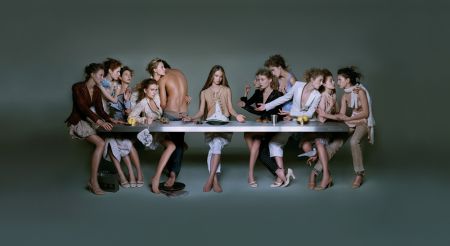
We felt pleasantly provoked by this ad for Marithe + Francois Girbaud, in which female models take up the mantles of Jesus and the Apostles for The Last Supper. There’s also a man that we’re guessing is supposed to be a Magdalene, or maybe a Judas, figure.

We love how the viewer is first slapped with recollection of the Da Vinci original, but beyond that the image merits a good long look. The facial expressions are wildly illustrative. And there don’t appear to be chairs or table legs.

The image drew heat in Italy for disrespecting religious sensibilities and replacing sacred symbols with merch. We’d argue that appropriating a religious painting (which, come on, wasn’t an accurate depiction anyway), then lacing it with a contemporary message, is a great way to put both the aesthetic and philosophical qualities of religion back on the discussion board.

Religious doctrine and art are ripe with symbols and rich stories, begging to be revived and reinterpreted. If advertising, as opposed to fresco, has to be our period eye, so be it.

What makes it less valid? Even the great painters were trying to get paid, and their sponsors – typically the monarchy or clergy – weren’t exactly proponents of the bohemian vision.


Picture of Steve Hall

Steve Hall

RECENT ARTICLES

TRENDING AROUND THE WEB

Psychologists say the bond between a person and the dog that sleeps in their bed isn’t comparable to human attachment. It’s actually more stable, because the dog never withdraws affection as punishment, never keeps score, and never makes closeness conditional on performance.

Psychologists say the bond between a person and the dog that sleeps in their bed isn’t comparable to human attachment. It’s actually more stable, because the dog never withdraws affection as punishment, never keeps score, and never makes closeness conditional on performance.

Global English Editing

The generation that performed stability even when they were barely holding on — boomers who kept immaculate homes, perfect lawns, and polished images while quietly falling apart — is finally putting down the mask, and this is what it looks like

The generation that performed stability even when they were barely holding on — boomers who kept immaculate homes, perfect lawns, and polished images while quietly falling apart — is finally putting down the mask, and this is what it looks like

Global English Editing

Psychology says adults with no close friends aren’t broken or antisocial — many of them simply learned early that the moment you show someone who you really are, that’s when they leave

Psychology says adults with no close friends aren’t broken or antisocial — many of them simply learned early that the moment you show someone who you really are, that’s when they leave

Global English Editing

Psychology says people who constantly try to become better versions of themselves aren’t actually growing — they’re running from a core belief that who they are right now isn’t enough, and that anxiety prevents the very self-acceptance that real growth requires

Psychology says people who constantly try to become better versions of themselves aren’t actually growing — they’re running from a core belief that who they are right now isn’t enough, and that anxiety prevents the very self-acceptance that real growth requires

Global English Editing

Research suggests that people who handwrite lists and people who use phone apps process their entire day differently. The paper list writers tend to plan from internal cues while the app users increasingly rely on external prompts, and over decades that difference quietly reshapes how autonomous a person feels inside their own life.

Research suggests that people who handwrite lists and people who use phone apps process their entire day differently. The paper list writers tend to plan from internal cues while the app users increasingly rely on external prompts, and over decades that difference quietly reshapes how autonomous a person feels inside their own life.

Global English Editing

Psychology says people who instinctively push their chair in when they leave a table aren’t just being polite – they grew up in households where someone always had to clean up after everyone else, and they never forgot what it felt like to be that person

Psychology says people who instinctively push their chair in when they leave a table aren’t just being polite – they grew up in households where someone always had to clean up after everyone else, and they never forgot what it felt like to be that person

Global English Editing