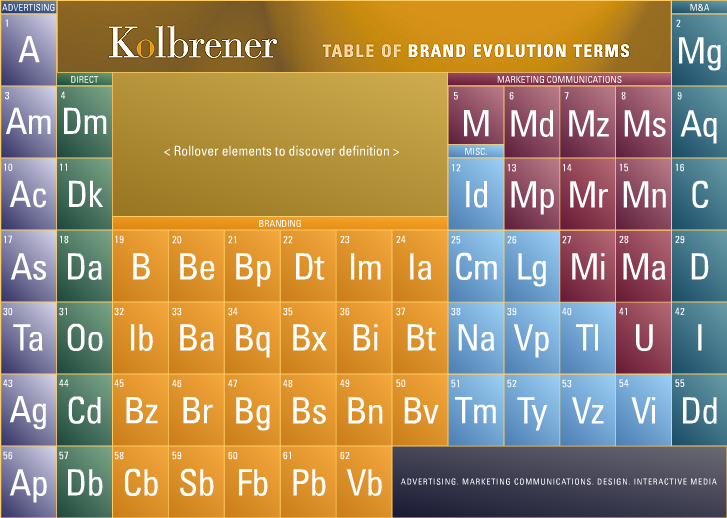
Kolbrener Compiles Branding Elements in Periodic Table

elements of branding.png

Hey, this is neat. In the style of the Periodic Table of Elements, Kolbrener put together a Table of Brand Evolution Terms. Each set is segmented by color under Advertising, Direct, Branding, Marketing Communications, M&A, and Misc.

We never thought we’d actually ever like playing with a table. If there were a way to incorporate it into an educational framework, that would be cooler still. (We remember learning a ton of these definitions in marketing class. There was no way to make that fun. Making it scientific, however, might add to the conceit that we’re all going to go off and do something important with our lives.)

Play with your elements here. Thanks to Allie at PETA for pointing it out.

Picture of Steve Hall

Steve Hall

RECENT ARTICLES

TRENDING AROUND THE WEB

7 things people who hit snooze five times a morning have in common

7 things people who hit snooze five times a morning have in common

Hack Spirit

7 things people who work with their hands understand that office workers rarely do

7 things people who work with their hands understand that office workers rarely do

Hack Spirit

7 things decisive people do differently than people who are just impulsive

7 things decisive people do differently than people who are just impulsive

Hack Spirit

8 things people who give thoughtful gifts pay attention to all year

8 things people who give thoughtful gifts pay attention to all year

Hack Spirit

Greif and Gleason’s 1980 research on how children learn politeness routines found that young children almost never say “please” or “thank you” spontaneously, they say it because a parent prompts them with “what do you say?” dozens of times a week, meaning the reflex adults later display without thinking twice was built through years of someone else’s prompting long before it became automatic.

Greif and Gleason’s 1980 research on how children learn politeness routines found that young children almost never say “please” or “thank you” spontaneously, they say it because a parent prompts them with “what do you say?” dozens of times a week, meaning the reflex adults later display without thinking twice was built through years of someone else’s prompting long before it became automatic.

Global English Editing

8 signs your in-laws see you as their own, not just someone their child married

8 signs your in-laws see you as their own, not just someone their child married

Hack Spirit