Kettle Potato Chips Want You to Crunch Proud

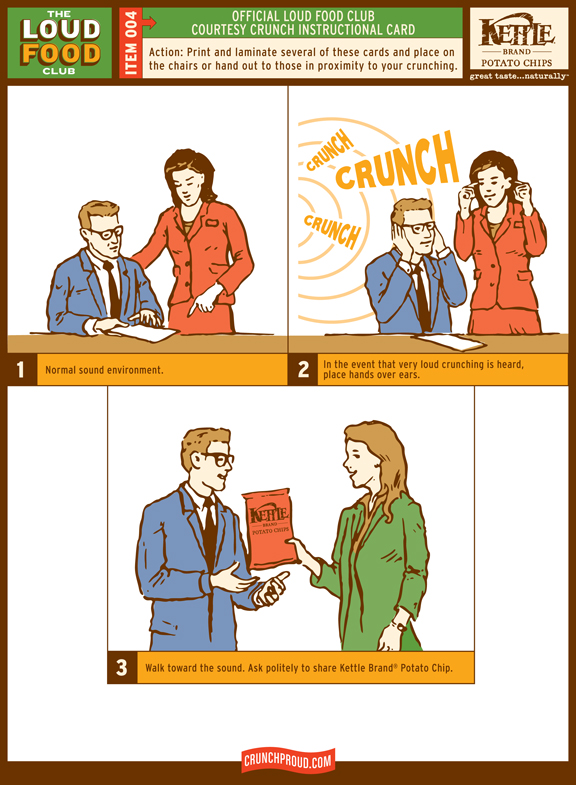
CltKtlLoudMemPictogram72.jpg

Do you love Kettle Potato Chips? Are they not the best potato chips you’ve ever had? If you haven’t had them, you should really try them. They are awesome and if you’re a lover you are now invited to join the Loud Food Club. The online promotion and sweepstakes is the first work from Cultivator Advertising & Design, Denver, for its new client, Kettle Foods, Salem, Ore.

At, Crunch Proud, a Loud Food Club meeting leader (with bullhorn) compares the sound of a Kettle chip’s crunch to a monster truck, a lion’s roar, and a electric guitar. He invites new members to take the LFC Pledge and then to download a membership kit, complete with interoffice disclaimer email, pictographic crunch courtesy instructions, an LFC pencil flag, and loud food crunch caution signage. Also available are a $1-off coupon and sweepstakes entry for the chance to win free Kettle chips for one year (but only15 bags per month. Um, that’s a lot of potato chips).

So if you’re a Kettle potato chip lover, this campaign’s for you. Oh wait, no it’s not. You’re already branded. So do the brand a solid and tell your Ruffles-loving friends to check out Kettle.


Picture of Steve Hall

Steve Hall

RECENT ARTICLES

TRENDING AROUND THE WEB

Psychologists explain that people who were never yelled at but always met with silence when they disappointed someone often develop a fear of calm that follows them into every adult relationship. They don’t flinch at anger. They flinch at quiet.

Psychologists explain that people who were never yelled at but always met with silence when they disappointed someone often develop a fear of calm that follows them into every adult relationship. They don’t flinch at anger. They flinch at quiet.

Global English Editing

I’m 73 and I just realized I have no close friends — not because I’m unlikeable, but because I spent forty years being pleasant to everyone and deep with no one, and now I don’t even know how to start

I’m 73 and I just realized I have no close friends — not because I’m unlikeable, but because I spent forty years being pleasant to everyone and deep with no one, and now I don’t even know how to start

Global English Editing

The difference between people who age into bitterness and people who age into warmth often comes down to one thing — Whether they treated happiness as something they deserved or something that grew naturally from how they chose to live each day

The difference between people who age into bitterness and people who age into warmth often comes down to one thing — Whether they treated happiness as something they deserved or something that grew naturally from how they chose to live each day

Global English Editing

The people who seem most at peace in their 60s and 70s didn’t find happiness by searching for it — they built lives where meaning, routine, and genuine connection left room for happiness to show up on its own terms

The people who seem most at peace in their 60s and 70s didn’t find happiness by searching for it — they built lives where meaning, routine, and genuine connection left room for happiness to show up on its own terms

Global English Editing

The generation that grew up in the 1950s and 60s wasn’t given a childhood — they were given a rehearsal for adulthood, handed responsibilities before they had finished being children, and then spent the rest of their lives wondering why they felt robbed of something they couldn’t quite name

The generation that grew up in the 1950s and 60s wasn’t given a childhood — they were given a rehearsal for adulthood, handed responsibilities before they had finished being children, and then spent the rest of their lives wondering why they felt robbed of something they couldn’t quite name

Global English Editing

The real reason boomer women who raised children, worked full-time, and cared for aging parents without complaining now struggle to accept help isn’t pride — it’s that their entire sense of worth was built around being the person who could handle everything, and slowing down feels like becoming irrelevant

The real reason boomer women who raised children, worked full-time, and cared for aging parents without complaining now struggle to accept help isn’t pride — it’s that their entire sense of worth was built around being the person who could handle everything, and slowing down feels like becoming irrelevant

Global English Editing