
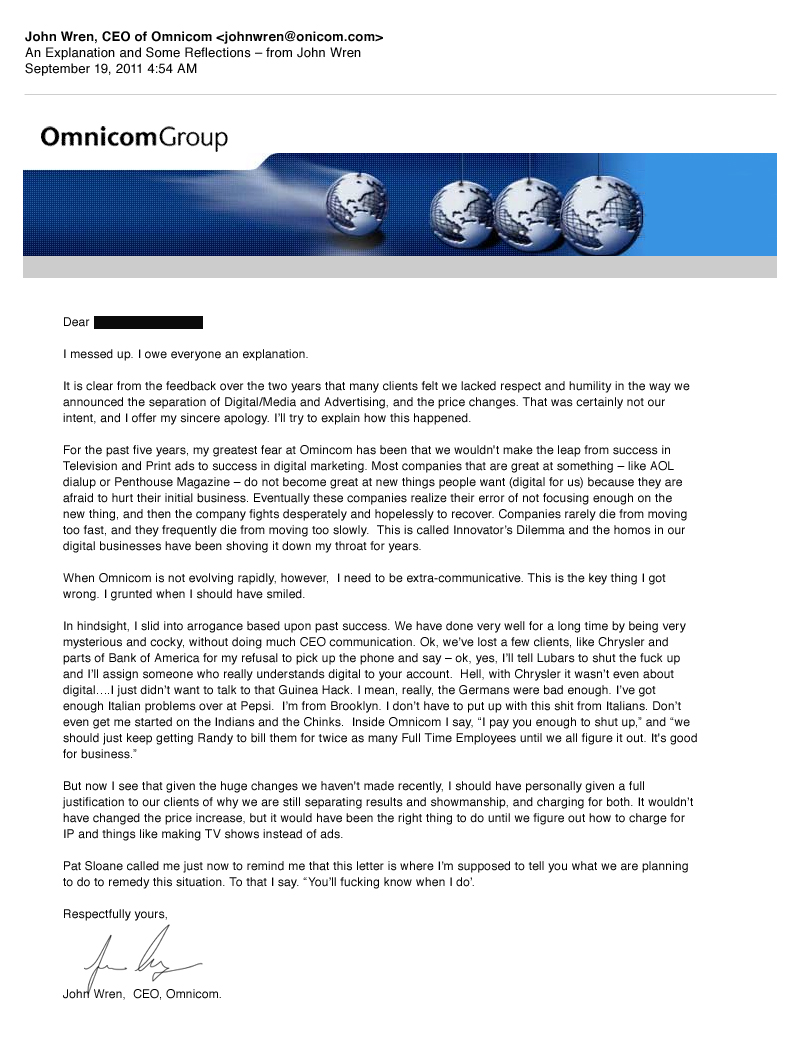
John Wren’ Explains Omnicom’s Netflix-Like Changes

NetflixHomage_Wren.jpeg

Let’s be clear right up front. This letter was not written by the real John Wren. If it were, it would be career suicide and a giant middle finger lodged in the behind of shareholders. But let’s not let that stop us from enjoying the humor within.

Whomever wrote this letter created in the style of the letter everyone on the internet received from Netflix today explaining the company’s recent price change and the launch of Qwikster. The ‘John Wren’ letter is far more amusing and will give you something to chuckle over on a Monday afternoon. Click the image to read.


Picture of Steve Hall

Steve Hall

RECENT ARTICLES

TRENDING AROUND THE WEB

I spent a decade trying to change myself into someone happier and the breakthrough came when I realized the version of me I was trying to build was just a more polished copy of someone else — and the person I actually needed to become was the one I’d been running from since I was nineteen

I spent a decade trying to change myself into someone happier and the breakthrough came when I realized the version of me I was trying to build was just a more polished copy of someone else — and the person I actually needed to become was the one I’d been running from since I was nineteen

Global English Editing

Psychology says the most accomplished boomers in their 70s spend their free time in ways their 40-year-old selves would have found embarrassing—slowly, unproductively, without measurable outcome—and the ones who made that transition most completely are almost always the ones who describe their later years as the happiest, because they finally stopped performing success and started actually experiencing their own life

Psychology says the most accomplished boomers in their 70s spend their free time in ways their 40-year-old selves would have found embarrassing—slowly, unproductively, without measurable outcome—and the ones who made that transition most completely are almost always the ones who describe their later years as the happiest, because they finally stopped performing success and started actually experiencing their own life

Global English Editing

The real digital divide in the age of AI isn’t between young and old. It’s between people who trust the first answer they’re given and people who’ve spent a lifetime learning to interrogate confident-sounding nonsense. That second group skews much older than the tech industry wants to admit

The real digital divide in the age of AI isn’t between young and old. It’s between people who trust the first answer they’re given and people who’ve spent a lifetime learning to interrogate confident-sounding nonsense. That second group skews much older than the tech industry wants to admit

Global English Editing

Psychology says the difference between being kind and compulsive people-pleasing is whether you can stop doing it without feeling like you’ve committed a crime — which is why some people physically cannot leave a messy restaurant table

Psychology says the difference between being kind and compulsive people-pleasing is whether you can stop doing it without feeling like you’ve committed a crime — which is why some people physically cannot leave a messy restaurant table

Global English Editing

I’m 68 and the unhappiness didn’t arrive suddenly. It came the day I realized I’d spent forty years building a life that required me to be needed, and now nobody needs me for anything that actually matters

I’m 68 and the unhappiness didn’t arrive suddenly. It came the day I realized I’d spent forty years building a life that required me to be needed, and now nobody needs me for anything that actually matters

Global English Editing

Psychology says the boomer women who are most difficult to be close to in later life aren’t the ones who suffered most—they’re the ones who spent decades converting their suffering into a permanent orientation towards the world, one that keeps score, expects compensation, and experiences other people’s happiness as a quiet affront to everything they’ve had to endure

Psychology says the boomer women who are most difficult to be close to in later life aren’t the ones who suffered most—they’re the ones who spent decades converting their suffering into a permanent orientation towards the world, one that keeps score, expects compensation, and experiences other people’s happiness as a quiet affront to everything they’ve had to endure

Global English Editing