
Infographic Explains What We Already Know: People Distrust Ads

lab42_infographic_small.png

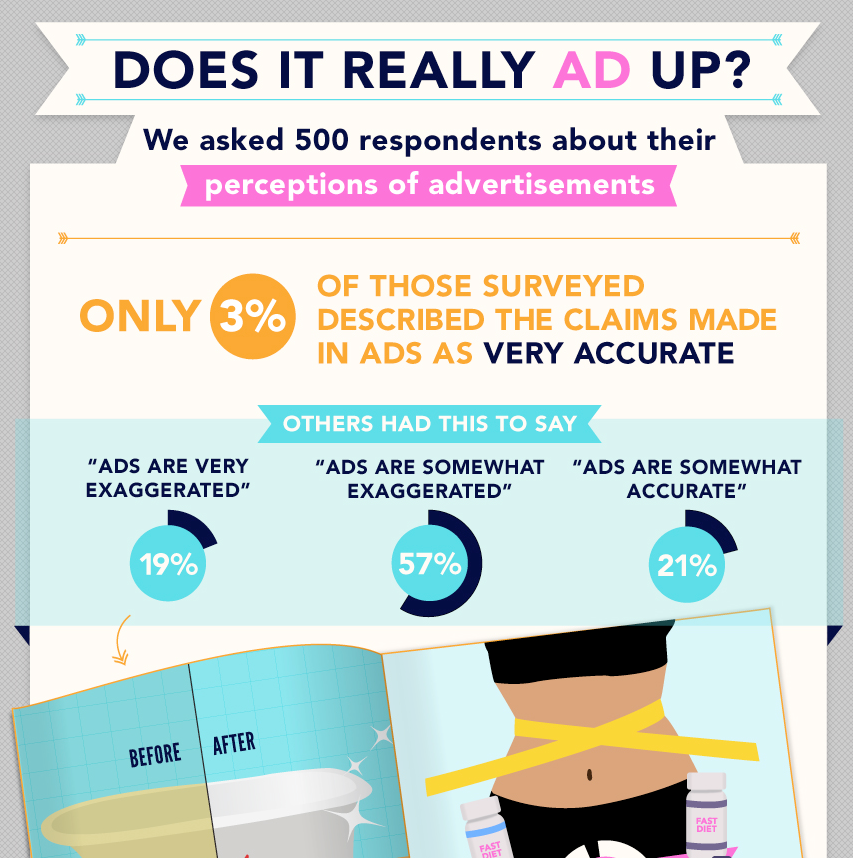
A new infographic produced by market researcher Lab42 reveals a stunning discovery; 76 percent of people think ads are somewhat or very exaggerated. Well slap me upside the head with an SRDS book. Who knew?

In other stunning findings, 96 percent of the 500 folks Lab42 surveyed believe half or more of all weight loss ads are photoshopped. Bet this makes Jessica Simpson pretty angry.

While it’s obvious the majority of people distrust advertising, just 17 percent wish there were more laws to regulate advertising. Guess everyone’s fine with being duped.

Oh and when it comes to types of ads that make a product memorable, eight percent approve of the sex sells approach. Unsurprisingly, 92 percent of that eight percent were men. Men do love their sex.

But humor trumps all with 71 percent of respondents stating a funny ad makes them more likely to remember a product.

Of course, this is a study of what kind of advertising people SAY influences them; not a study of what ACTUALLY influences them. Apples and oranges, people. Apples and oranges.

lab42_infographic_advertising.jpg

Picture of Steve Hall

Steve Hall

RECENT ARTICLES

TRENDING AROUND THE WEB

8 things people who give thoughtful gifts pay attention to all year

8 things people who give thoughtful gifts pay attention to all year

Hack Spirit

Greif and Gleason’s 1980 research on how children learn politeness routines found that young children almost never say “please” or “thank you” spontaneously, they say it because a parent prompts them with “what do you say?” dozens of times a week, meaning the reflex adults later display without thinking twice was built through years of someone else’s prompting long before it became automatic.

Greif and Gleason’s 1980 research on how children learn politeness routines found that young children almost never say “please” or “thank you” spontaneously, they say it because a parent prompts them with “what do you say?” dozens of times a week, meaning the reflex adults later display without thinking twice was built through years of someone else’s prompting long before it became automatic.

Global English Editing

8 signs your in-laws see you as their own, not just someone their child married

8 signs your in-laws see you as their own, not just someone their child married

Hack Spirit

Many adult children remember watching a father work sixty-hour weeks for decades so the family could have what he never did, then watched him die in his sixties without ever prioritizing his own happiness, and now see that same pattern quietly repeating in their own lives, under a different name.

Many adult children remember watching a father work sixty-hour weeks for decades so the family could have what he never did, then watched him die in his sixties without ever prioritizing his own happiness, and now see that same pattern quietly repeating in their own lives, under a different name.

Global English Editing

Harvard researchers had 166 undergraduates rate their own pets on qualities like thoughtful, considerate and sympathetic, and the students who felt most chronically disconnected from other people scored their pets meaningfully higher on exactly those three traits, and no others.

Harvard researchers had 166 undergraduates rate their own pets on qualities like thoughtful, considerate and sympathetic, and the students who felt most chronically disconnected from other people scored their pets meaningfully higher on exactly those three traits, and no others.

Global English Editing

University of Arizona researchers wired 79 people with a recorder sampling conversations every 12.5 minutes for four days and found the happiest had twice as many substantive conversations and a third as much small talk as the unhappiest, suggesting the discomfort was never a social deficit.

University of Arizona researchers wired 79 people with a recorder sampling conversations every 12.5 minutes for four days and found the happiest had twice as many substantive conversations and a third as much small talk as the unhappiest, suggesting the discomfort was never a social deficit.

Global English Editing











