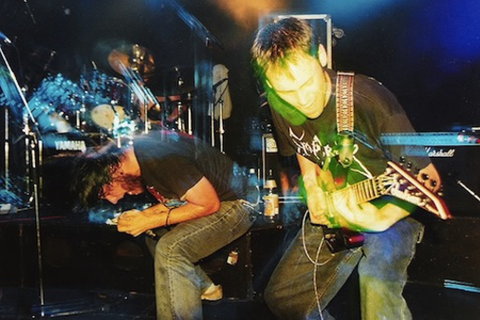
TBWAChiatDay New York Head of Planning, Ed Castillo, attended a SXSW panel entitled Anarchists to Sell-Out: Punks Make Better CEOs and had these thoughts to share.
The presentation I enjoyed most at SXSWi was “Anarchist to Sell-Out: Punks Make Better CEOs” by Deep Local CEO Nathan Martin. Martin’s candid account of his journey from skate punk, to electronics anarchist, to metal front man, to tactical-media artist and agitator, to design professor, to creative technologist for hire (my characterizations, not his) was a provocative and inspiring story about embracing the disruptive force of creativity and living strictly on one’s own terms. In a career punctuated by hacking the Nintendo Gameboy, trading sex for votes, and Nike Chalkbot, Martin has apparently found a way to participate meaningfully in the circus that is brand marketing while staying true to the idealism of his art and the hacktivism of his youth.
Of particular interest to me is his role in metal/punk/grindcore/noise outfit Creation is Crucifixion. As Martin recounted his experiences touring with this band of developer and technologist types, I couldn’t help but think about my own metalhead friends, and their tendency to be gear-heady, catharsis inclined jonesers who are fond of making things. And just hours after hearing Martin’s presentation, the idea that ‘metal and making’ may be linked in some fundamental way presented itself again while having drinks with colleagues from TBWADigital Arts Network (I was with an Aussie, a Brit, and two Finns; all of whom are metal heads). As we prepared ourselves to attend the Metal Monsters of Texas Unofficial SXSW Showcase, the conversation moved effortlessly from the latest double-bass-drum techniques by Meshuggah’s Thomas Haake, to isolating video game music soundtracks from their gameplay context for iPod listening, to admiring the new Fractal Axe-FX II guitar amp emulator, to sussing out how we might share Pro Tools and Cubase files to collaborate remotely on original music, to describing the joys of listening to metal while writing code; all ostensibly conversations about making stuff.
…So what is the connection – if any – between making “stuff” (which, for the purpose of this article means “creative expressions for commercial gain”) and loving metal?
The most obvious connection may be the roles of technique and gear/tools in the making of stuff, and in metal. Many metalheads are musicians, but even if they aren’t, they can typically distinguish a Marshall from a Mesa/Boogie, or a Fender from a Gibson. More generally, they’ll likely also have an appetite for discussing the hardware, software, operating systems, and programming languages used to make video and audio content (and they might even want to discuss the power, control, microelectronics, and signal processing that goes into making even more tangible “stuff”).
[In case you hadn’t noticed, the Creation is Crucifixion song I posted above is called “Antenna Builder (aka Engineer an Inverse Cellular Network).”]Looking deeper, though, I see something more interesting in the preponderance of creative minds being drawn to what the masses experience as cacophony. Hard/heavy music fandom (from metal to industrial to punk and beyond) can be characterized as being made up of “subcultures of alienation” which have their own sets of unwritten rules (distributed tribally across the sub-groups that make up the larger hard/heavy musical taxonomy). These rules compel tribe members to oppose mainstream, established…popular means of expression.
That is to say that these rules compel metalheads to be disruptors (which is near to my heart as an employee of TBWA).
If you’ve never experienced a discussion of metal’s sub-generic classifications, you might be surprised to learn how fragmented these sub-genres can be, which in turn can lead to wildly over-thought classification schemes (e.g., I recently argued with a friend for an hour about whether Poland’s Decapitated is “ultra-technical death metal” or simply “modern math metal”).
What’s more likely the case is that you just don’t care, which is precisely the point. Subcultures of alienation thrive on being alien, at least in comparison with the larger population (even if they demonstrate a remarkable uniformity within their own tribe [think black concert T-shirts and long hair on men]).
At the center of all this tribalism is freedom from convention (well, those not imposed by the tribe, at least) and a constant opportunity for cathartic expression. And these are the very roots of creativity.
Every one of us is born creative, expressive and comfortable with ourselves. But over time, schools, churches and other institutions force us to focus on the “right” and “wrong” answers, and this fades.
(An idea quickly and elegantly represented here https://youtu.be/n3EQT-TYv_0)
I can’t know whether any of this armchair anthropology is manifest in Nathan Martin’s creative work, his sense-of-self, or in the work or senses-of-self of any other of the creative metalheads who seem to surround me. I can tell you, however, that Martin’s SXSW presentation compelled me to take notice and think about these issues, and for that I’m thankful.
Nathan Martin is “still metal,” even if he is no longer screaming and growling on performance space stages.