Hot Women in Ads? Get Used to it. They’re Here to Stay

hunky_dorks_stare_crisps.jpg

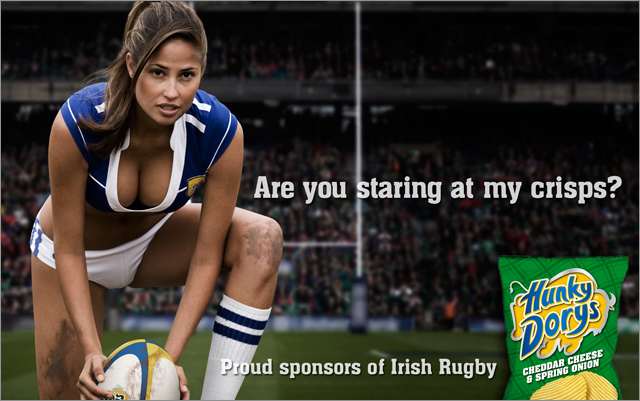
AdFreak describes new work from Hunky Dorys as “an advertising campaign that pairs scantily clad females playing a contact sport with suggestive headlines in a blatant attempt to curry favor with the young male target market.”

Um. Well, isn’t that the entire point? What’s blatant about using images of hot, half-dressed women to catch men’s attention? It’s basic human nature. Men love hot women. Men want to be with hot women. And when they can’t…which is most the time…they settle for staring at hot women. In magazines. On TV. On the internet, In porn flicks. And, yes, in advertising which, if you think about it, is really a public service of sorts.

Keep a man happy with hot women in ads and they might not stray to more prurient and dangerous behaviors. Hey, it’s just a thought. And besides, what man really wants to stop seeing hot women in suggestive ads?

As long as men are on this planet, the collective desire to see hot women in various states of undress will never cease.

So yes, men think women are scrumptious, they want them as their own, they want to tackle them and hey will never stop staring at their crisps.


Picture of Steve Hall

Steve Hall

RECENT ARTICLES

TRENDING AROUND THE WEB

Studies on helicopter parenting link the behavior to parents’ own fear of danger and discomfort with separation, complicating the popular idea that constant helping is simply an extension of love

Studies on helicopter parenting link the behavior to parents’ own fear of danger and discomfort with separation, complicating the popular idea that constant helping is simply an extension of love

Global English Editing

A vocabulary that keeps quietly expanding well past someone’s twenties isn’t just a love of words — it’s the one measure of intelligence psychologists have trusted for a century because it tracks so closely with how a person actually thinks

A vocabulary that keeps quietly expanding well past someone’s twenties isn’t just a love of words — it’s the one measure of intelligence psychologists have trusted for a century because it tracks so closely with how a person actually thinks

Global English Editing

An Adobe survey found 69% of workers say emoji use makes a coworker seem more likable — and the reason has more to do with replacing missing body language than making a message friendlier

An Adobe survey found 69% of workers say emoji use makes a coworker seem more likable — and the reason has more to do with replacing missing body language than making a message friendlier

Global English Editing

A boundary delivered without an explanation usually isn’t coldness — it’s someone who’s learned that the explanation is exactly what invites the negotiation they were trying to avoid

A boundary delivered without an explanation usually isn’t coldness — it’s someone who’s learned that the explanation is exactly what invites the negotiation they were trying to avoid

Global English Editing

Someone who lets a frazzled stranger go ahead of them in line isn’t necessarily being generous — they’re picking up on small shifts in tone and posture that most people only catch when told to look for them

Someone who lets a frazzled stranger go ahead of them in line isn’t necessarily being generous — they’re picking up on small shifts in tone and posture that most people only catch when told to look for them

Global English Editing

The difference between the words you recognize and the words you actually use — and what that gap says about how you learned them

The difference between the words you recognize and the words you actually use — and what that gap says about how you learned them

Global English Editing