Hitwise Says Facebook Still Rules Over Google’s OpenSocial

opensocial2.png

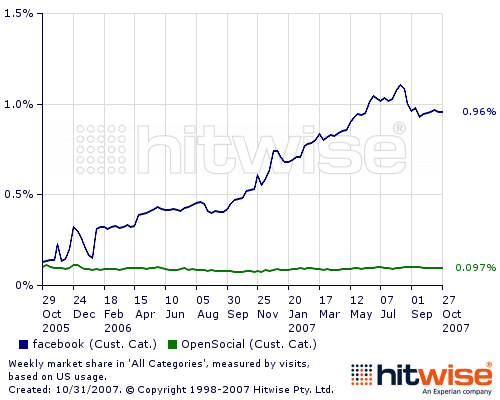
Hitwise took a look at Google recent announcement about its new social networking endeavors and how that partnership stack up against social networking giant Facebook. Adding together the heft of LinkedIn, Plazo, Friendster, and Hi5 (though there may be others added), Hitwise concluded Facebook is still ten times larger than Google’s OpenSocial architecture.

Now, that’s not to say Google isn’t going to widgetize everything to the point where it could become a portal in a sense for every social network a person belongs to. It’s clear most people belong to more than one social network and pulling those together with some sort or connective portal makes a lot of sense. In fact, several companies are already doing just that but none with the heft of Google.

Google mission is to organize the world’s information. Social networking has fostered an explosion of information ripe for the picking and monetization. Google isn’t going to miss out on this one.


Picture of Steve Hall

Steve Hall

RECENT ARTICLES

TRENDING AROUND THE WEB

Nobody talks about the version of loneliness that lives inside a perfectly fine marriage—the kind where nothing is wrong, nobody is cruel, the partnership functions exactly as designed—but somewhere around year twenty-five one person realized they’d been having their most honest conversations in their own head

Nobody talks about the version of loneliness that lives inside a perfectly fine marriage—the kind where nothing is wrong, nobody is cruel, the partnership functions exactly as designed—but somewhere around year twenty-five one person realized they’d been having their most honest conversations in their own head

Global English Editing

The Boomer generation that could sit through a three-hour family dinner without once reaching for a screen developed a tolerance for unstructured time that most people under 40 now medicate, distract, or schedule away—and behavioral scientists say that tolerance is one of the strongest predictors of emotional stability in later life

The Boomer generation that could sit through a three-hour family dinner without once reaching for a screen developed a tolerance for unstructured time that most people under 40 now medicate, distract, or schedule away—and behavioral scientists say that tolerance is one of the strongest predictors of emotional stability in later life

Global English Editing

I’m 73 and the thing that keeps me up at night isn’t fear of dying—it’s the possibility that my children will clean out this house in a weekend and not understand that every drawer, every shelf, every pile they’ll throw away was a sentence in a conversation I was trying to have with them

I’m 73 and the thing that keeps me up at night isn’t fear of dying—it’s the possibility that my children will clean out this house in a weekend and not understand that every drawer, every shelf, every pile they’ll throw away was a sentence in a conversation I was trying to have with them

Global English Editing

I’m 63 and I nursed other people’s pain for forty-four years and the thing I never told anyone is that I learned how to hold space for everyone else’s suffering by completely forgetting that mine was supposed to count too

I’m 63 and I nursed other people’s pain for forty-four years and the thing I never told anyone is that I learned how to hold space for everyone else’s suffering by completely forgetting that mine was supposed to count too

Global English Editing

8 things about my husband I only understood after forty years of marriage—and wished I’d known by year five

8 things about my husband I only understood after forty years of marriage—and wished I’d known by year five

Global English Editing

The sad truth why adult children slowly stop sharing real things with their parents has nothing to do with distance or busy schedules—it’s that somewhere in their 30s they realized their parent would either worry too much, give advice they didn’t ask for, or make it about themselves, and the silence was easier than managing any of those three responses

The sad truth why adult children slowly stop sharing real things with their parents has nothing to do with distance or busy schedules—it’s that somewhere in their 30s they realized their parent would either worry too much, give advice they didn’t ask for, or make it about themselves, and the silence was easier than managing any of those three responses

Global English Editing