Ford in Hot Water Over Ads Featuring Bound, Gagged, Barely Dressed Hotties

ford_figo_three.jpg

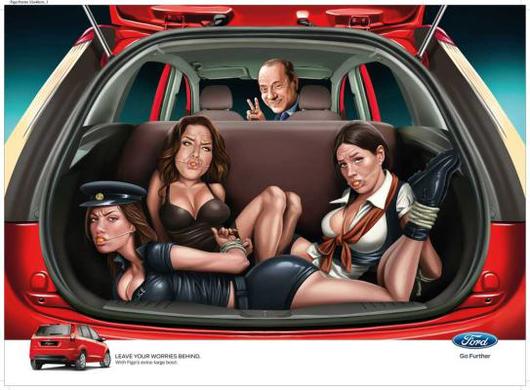
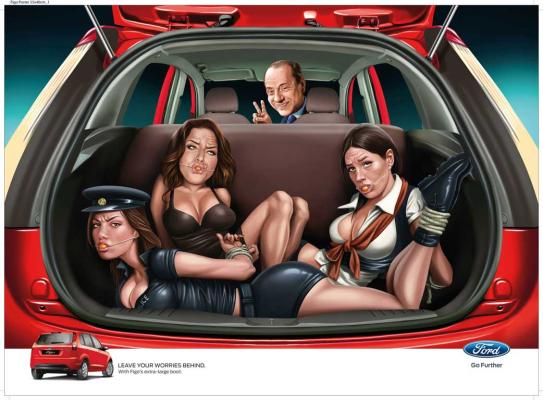
An ad campaign created by an Indian agency for Ford has come under fire for its creative approach. Three ads, which tout the brand’s Indian-made Ford Figo, feature cartoon characatures of women (and men) bound and gagged in the vehicle’s trunk.

Ford has issued an apology which, in part, reads, “We deeply regret the publishing of posters that were distasteful and contrary to the standards of professionalism and decency within WPP Group. These were never intended for paid publication and should never have been created, let alone uploaded to the internet. This was the result of individuals acting without proper oversight and appropriate actions have been taken within the agency.”

One ad features Paris Hilton along with Khloe, Kourtney and Kim Kardashian. A second ad features former Italian Prime Minister Silvio Berlusconi with three busty women. And a third features Formula One racer Michael Schumacher with three other racers, Sebastian Vettel, Lewis Hamilton and Fernando Alonso tied up in the back.

The ads, never intended for publication, were leaked to the internet.

Of the ads, the Ford statement continued, “The posters are contrary to the standards of professionalism and decency within Ford and our agency partners. Together with our partners, we are reviewing approval and oversight processes to help ensure nothing like this ever happens again.”

But, but, but…wouldn’t it be cool to open your trunk and find three hot guys or girls waiting to be rescued? Just think of the fun you could have with that. OK, OK, while we’re sure the creative team was going for some sort of dark humor, these sort of attempts rarely frly with a mainstream brand…let alone any brand.

ford_figo_three.jpg

ford_figo_racer.jpg

ford_figo_kardashians.jpg

Picture of Steve Hall

Steve Hall

RECENT ARTICLES

TRENDING AROUND THE WEB

University of Arizona researchers wired 79 people with a recorder sampling conversations every 12.5 minutes for four days and found the happiest had twice as many substantive conversations and a third as much small talk as the unhappiest, suggesting the discomfort was never a social deficit.

University of Arizona researchers wired 79 people with a recorder sampling conversations every 12.5 minutes for four days and found the happiest had twice as many substantive conversations and a third as much small talk as the unhappiest, suggesting the discomfort was never a social deficit.

Global English Editing

A landmark study found that Catholic nuns who wrote sparse, simple autobiographies in their early twenties, when they entered the convent in the 1930s, were far more likely to develop Alzheimer’s disease roughly six decades later, with about 80 percent of the low-complexity writers eventually developing the disease compared to only 10 percent of those whose youthful essays were dense with ideas

A landmark study found that Catholic nuns who wrote sparse, simple autobiographies in their early twenties, when they entered the convent in the 1930s, were far more likely to develop Alzheimer’s disease roughly six decades later, with about 80 percent of the low-complexity writers eventually developing the disease compared to only 10 percent of those whose youthful essays were dense with ideas

Global English Editing

Jordan Peterson opens Rule 6 of “12 Rules for Life” by asking, “If you can’t even clean up your own room, who the hell are you to give advice to the world?” — arguing that the discipline to fix a small mess is the same discipline a marriage, a career, or a country eventually demands.

Jordan Peterson opens Rule 6 of “12 Rules for Life” by asking, “If you can’t even clean up your own room, who the hell are you to give advice to the world?” — arguing that the discipline to fix a small mess is the same discipline a marriage, a career, or a country eventually demands.

Global English Editing

9 habits that give away someone who grew up in a big family

9 habits that give away someone who grew up in a big family

Hack Spirit

Psychologists did not coin emotional intelligence until 1990, and Goleman’s book did not popularize it until 1995, so people raised between 1945 and 1975 grew up with no shared vocabulary for feelings, many still improvising one from watching, guessing, and going quiet when intimacy calls for words.

Psychologists did not coin emotional intelligence until 1990, and Goleman’s book did not popularize it until 1995, so people raised between 1945 and 1975 grew up with no shared vocabulary for feelings, many still improvising one from watching, guessing, and going quiet when intimacy calls for words.

Global English Editing

8 things dog owners do that reveal more about them than they realise

8 things dog owners do that reveal more about them than they realise

Hack Spirit