
Facebook Traffic Declines, Time Spent Increases

facebook_hitwise_decline.png

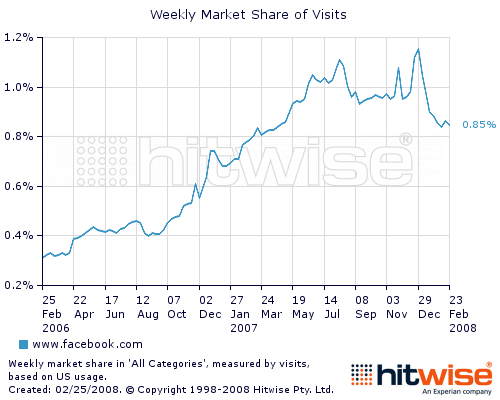
Perhaps it’s application fatigue. Perhaps it’s incessant friend request. Perhaps it’s social media overload but according to Hitwise, traffic to Facebook is down 27 percent for the week ending February 23 from a high during the holidays.

Hitwise acknowledges this could be a seasonal trend citing traffic increases during both the Thanksgiving and Christmas breaks due to a significant portion of Facebook’s users (40 percent 18-24) being out of school and having more time to use the site.

Even with some decline, the average time spent on Face book has steadily increased from just under five seconds in February 2006 to 21 seconds in February 2008. Noting recent peaks in traffic coincide with less time spent on the site, Hitwise hypothesizes the traffic increases are coming from less active users.

As we’ve said before, people come and people go. When a shiny new object shows up, everyone at least has to check it out. It’s unclear if there’s actually a new shiny object out there at this point aside from an expansive plethora of widgetized web 2.0 goodies but Facebook’s shine won’t last forever.


Picture of Steve Hall

Steve Hall

RECENT ARTICLES

TRENDING AROUND THE WEB

Psychology says the loneliest part of being an aging parent isn’t being alone – it’s realizing your children love you but don’t actually enjoy spending time with you, and understanding that gap is something you created decades ago

Psychology says the loneliest part of being an aging parent isn’t being alone – it’s realizing your children love you but don’t actually enjoy spending time with you, and understanding that gap is something you created decades ago

Global English Editing

Psychology says the freedom that childless couples experience in midlife carries a hidden cost. Without the natural structure that children impose on time, weekends, holidays, and decades, they must generate their own sense of purpose continuously, and that ongoing act of self-creation is both the privilege and the exhaustion nobody warns them about.

Psychology says the freedom that childless couples experience in midlife carries a hidden cost. Without the natural structure that children impose on time, weekends, holidays, and decades, they must generate their own sense of purpose continuously, and that ongoing act of self-creation is both the privilege and the exhaustion nobody warns them about.

Global English Editing

Psychology says staying silent in these 8 specific situations isn’t weakness or avoidance—it’s the most precise form of self-respect that most people only learn after saying the wrong thing one too many times

Psychology says staying silent in these 8 specific situations isn’t weakness or avoidance—it’s the most precise form of self-respect that most people only learn after saying the wrong thing one too many times

Global English Editing

I raised three kids, worked full time, and kept a marriage together for forty years, and my son told me over dinner that my generation had it easy. I didn’t argue. I just felt something close quietly inside me.

I raised three kids, worked full time, and kept a marriage together for forty years, and my son told me over dinner that my generation had it easy. I didn’t argue. I just felt something close quietly inside me.

Global English Editing

Psychology says the reason you can’t maintain self-discipline isn’t lack of willpower — it’s that you’re trying to force a behavior your nervous system has learned to associate with punishment, criticism, or being unloved

Psychology says the reason you can’t maintain self-discipline isn’t lack of willpower — it’s that you’re trying to force a behavior your nervous system has learned to associate with punishment, criticism, or being unloved

Global English Editing

Psychology says people who pretend not to see acquaintances in public to avoid small talk aren’t rude—they’re running a very efficient internal cost-benefit analysis that extroverts simply don’t have the software for

Psychology says people who pretend not to see acquaintances in public to avoid small talk aren’t rude—they’re running a very efficient internal cost-benefit analysis that extroverts simply don’t have the software for

Global English Editing










