Facebook Hates Breast Feeding

boobs_breastfeeding.jpg

We all know Facebook has a twisted outlook when it comes to privacy and all things related to acceptable content on its site. Writing on Work That Matters, Tom Megginson takes a close look at Facebook’s stance on breastfeeding.

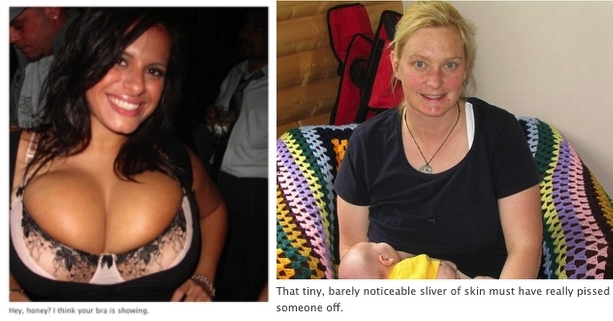
With a collection of images that compares the site’s apparent love for the sensationalizing of large breasts and apparent disdain for a practice that simply nourishes a child, Megginson points out Facebook’s seemingly twisted sense of acceptability when it comes to nudity and the female breast.

Expanding on the point, Megginson writes, “And there you have the hypocrisy. Younger female Facebook users are known for posting questionable ‘cleavage’ shots of themselves. Nobody complains. Men post semi-pornographic images in the lad’s groups, and keep them to themselves. But for some reason, breastfeeding seems to be targeted. I can’t imagine what anti-breastfeeding people are doing in groups, pages and photo albums that are clearly intended for people who want to share – and advocate for – the natural feeding of babies. Who on earth is complaining about these pictures?”

Who, indeed? Yes, Megginson is aware Facebook is a private company and can do whatever the hell it wants but with 500 million users across the globe, this censorship reeks of puritanical American hypocrisy. Thoughts?


Picture of Steve Hall

Steve Hall

RECENT ARTICLES

TRENDING AROUND THE WEB

7 things decisive people do differently than people who are just impulsive

7 things decisive people do differently than people who are just impulsive

Hack Spirit

8 things people who give thoughtful gifts pay attention to all year

8 things people who give thoughtful gifts pay attention to all year

Hack Spirit

Greif and Gleason’s 1980 research on how children learn politeness routines found that young children almost never say “please” or “thank you” spontaneously, they say it because a parent prompts them with “what do you say?” dozens of times a week, meaning the reflex adults later display without thinking twice was built through years of someone else’s prompting long before it became automatic.

Greif and Gleason’s 1980 research on how children learn politeness routines found that young children almost never say “please” or “thank you” spontaneously, they say it because a parent prompts them with “what do you say?” dozens of times a week, meaning the reflex adults later display without thinking twice was built through years of someone else’s prompting long before it became automatic.

Global English Editing

8 signs your in-laws see you as their own, not just someone their child married

8 signs your in-laws see you as their own, not just someone their child married

Hack Spirit

Many adult children remember watching a father work sixty-hour weeks for decades so the family could have what he never did, then watched him die in his sixties without ever prioritizing his own happiness, and now see that same pattern quietly repeating in their own lives, under a different name.

Many adult children remember watching a father work sixty-hour weeks for decades so the family could have what he never did, then watched him die in his sixties without ever prioritizing his own happiness, and now see that same pattern quietly repeating in their own lives, under a different name.

Global English Editing

Harvard researchers had 166 undergraduates rate their own pets on qualities like thoughtful, considerate and sympathetic, and the students who felt most chronically disconnected from other people scored their pets meaningfully higher on exactly those three traits, and no others.

Harvard researchers had 166 undergraduates rate their own pets on qualities like thoughtful, considerate and sympathetic, and the students who felt most chronically disconnected from other people scored their pets meaningfully higher on exactly those three traits, and no others.

Global English Editing