DISH’s Talk Boston Teaches You How to ‘Pahk the Cah in Havahd Yahd’

dish_kahkeez.png

Having come from Boston myself, the Boston accent is something very familiar to my ears. Though I don’t really have a Boston accent (parents weren’t from Boston), I have an ear for it and can spot all those fake Boston accents in movies from a mile away.

When DISH launched its recent campaign featuring the Boston Guys talking about the service’s Hopper (Hoppa), I was pleasantly thrilled to see the Boston accent done right. The Boston Guys campaign, created by Barton F. Graf 9000 (or Baaahton F. Graaahf 9000 as AdWeek’s David Gianatasio once called them), began about a year ago and was so loved the agency kept giving us more and more.

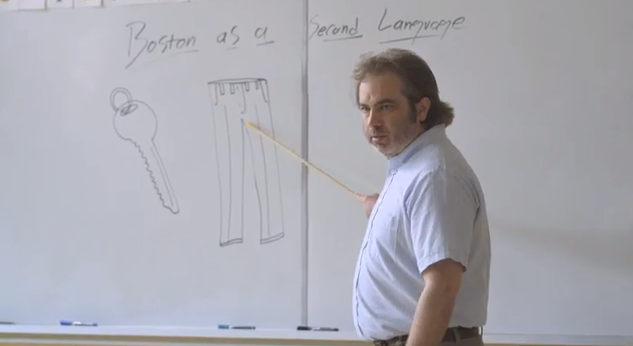
The latest entry in the Boston Guys campaign is Talk Boston, a site on which one can learn howe to properly pronounce certain words in the Boston accent. The campaign also includes a series of videos entitled Boston as a Second Language which educates viewers how to properly pronounce car keys or khakis (Kahkeez), Bar Harbor (Bah Habah), Hopper (Hoppa), Offer (Awfa) and Escalator (Escalayta).

The true Boston accent, like many accents, is not easy to replicate if you aren’t native to the area. And even though some of the words used in the campaign are “stretched” a bit for hilarity’s sake, the pronunciation, for the most part, is genuine.

Another element of the Talk Boston site tests your ability to “speak” the Boston accent by showing you phonetic spellings of words spoken in the Boston accent which you then translate into “correct” English. The test gives you one minute. I scored a 65% which is wicked bad. (Catch that?)

Talk Boston is a wonderful extension of a long-running, successful campaign that has helped DISH achieved significant notoriety. Though it doesn’t seem to have done much for revenue recently.

YouTube video

YouTube video

YouTube video

YouTube video

YouTube video

Picture of Steve Hall

Steve Hall

RECENT ARTICLES

TRENDING AROUND THE WEB

I’m 73 and my husband leaves every surface destroyed when he cooks and then cleans it all afterward in one heroic effort — and I clean as I go and present a meal from a kitchen that looks like nobody used it — and we’ve been having the same argument about this for 44 years without realizing that it’s not about dishes, it’s about two fundamentally different philosophies of how to move through chaos, and the kitchen is just the room where the philosophies collide three times a day

I’m 73 and my husband leaves every surface destroyed when he cooks and then cleans it all afterward in one heroic effort — and I clean as I go and present a meal from a kitchen that looks like nobody used it — and we’ve been having the same argument about this for 44 years without realizing that it’s not about dishes, it’s about two fundamentally different philosophies of how to move through chaos, and the kitchen is just the room where the philosophies collide three times a day

Global English Editing

Psychology says parents who feel their adult children don’t love them aren’t being dramatic — they’re detecting the difference between maintenance-level contact and genuine emotional investment, and that distinction becomes unbearable once you finally notice it

Psychology says parents who feel their adult children don’t love them aren’t being dramatic — they’re detecting the difference between maintenance-level contact and genuine emotional investment, and that distinction becomes unbearable once you finally notice it

Global English Editing

Psychologists explain that people who have to jiggle the door handle after locking it aren’t paranoid — they’re compensating for the fact that procedural memory doesn’t create the same confidence as episodic memory, which is why we trust what we just witnessed more than what we just did

Psychologists explain that people who have to jiggle the door handle after locking it aren’t paranoid — they’re compensating for the fact that procedural memory doesn’t create the same confidence as episodic memory, which is why we trust what we just witnessed more than what we just did

Global English Editing

The generation that was told they could have it all is now watching its childless members age into a healthcare system, inheritance framework, and social safety net that was built entirely around the assumption that everyone would have someone younger who cared enough to make the phone calls

The generation that was told they could have it all is now watching its childless members age into a healthcare system, inheritance framework, and social safety net that was built entirely around the assumption that everyone would have someone younger who cared enough to make the phone calls

Global English Editing

Research suggests adults who received minimal affection as children often become one of two things — either the most physically affectionate person in any room, overcompensating with a warmth they’re terrified of withholding, or the most physically reserved, maintaining a distance they don’t want but can’t override — and both responses are survival adaptations to the same wound, and neither one feels natural because neither one is, they’re both translations of an experience that was never given its original language

Research suggests adults who received minimal affection as children often become one of two things — either the most physically affectionate person in any room, overcompensating with a warmth they’re terrified of withholding, or the most physically reserved, maintaining a distance they don’t want but can’t override — and both responses are survival adaptations to the same wound, and neither one feels natural because neither one is, they’re both translations of an experience that was never given its original language

Global English Editing

Psychology says people who grew up with very little affection don’t become cold — they become hyper-competent, because when love isn’t freely given, achievement becomes the only language they know for earning value

Psychology says people who grew up with very little affection don’t become cold — they become hyper-competent, because when love isn’t freely given, achievement becomes the only language they know for earning value

Global English Editing