
Contextual Fuckery Solved by Actual Humans (Who Knew?)

live5_mediafront_contextual.gif

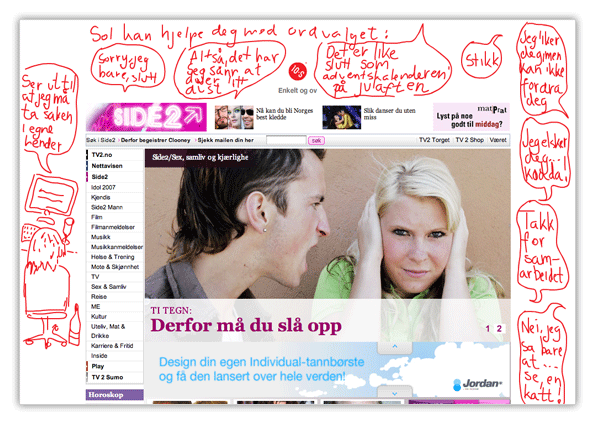
Now this is cool. We’ve already got contextual ads. We’ve already got behavioral ads. But we all know how much fuckery can sometimes come from those automated solutions. Wouldn’t it be cool if the content of banners were matched to the content of the page by an actual, intelligent human being as opposed to a garbage in/garbage out, brainless computer?

That’s exactly what Norwegian agency Mediafront did for news and entertainment site Sol. Three copywriters spent a combined 150 hours producing content resulting in 1,000 unique banners matched specifically to the sites on which they appeared. The copywriters, using a pen tablet and a custom publishing program delivered through Flash Media Server, monitored sites on which the campaign appeared and immediately created customized banner content specific to each site.

Take a look at several of the custom created banners here. If we could actually read the banners, we’d probably be even more excited about this than we actually are. This is great stuff. Common sense and doable. That is for agencies that don’t fall into the “set it and forget it” category of campaign management.


Picture of Steve Hall

Steve Hall

RECENT ARTICLES

TRENDING AROUND THE WEB

I spent my entire adult life planning for retirement and now at 65 I’m here and it feels like I’m watching a movie of someone else’s life in real-time — I know intellectually that this is my house, my wife, my days, but I can’t shake the sensation that I’m not really in it

I spent my entire adult life planning for retirement and now at 65 I’m here and it feels like I’m watching a movie of someone else’s life in real-time — I know intellectually that this is my house, my wife, my days, but I can’t shake the sensation that I’m not really in it

Global English Editing

I gave my kids everything I never had growing up and somewhere around age 63 I realized that’s exactly why they can’t appreciate it — they have no reference point for what life looks like without a parent who absorbs everything so they don’t have to

I gave my kids everything I never had growing up and somewhere around age 63 I realized that’s exactly why they can’t appreciate it — they have no reference point for what life looks like without a parent who absorbs everything so they don’t have to

Global English Editing

The loneliest people in retirement aren’t the ones without children — they’re the ones who built their entire identity around being needed and now sit in quiet houses waiting for phone calls that will never come

The loneliest people in retirement aren’t the ones without children — they’re the ones who built their entire identity around being needed and now sit in quiet houses waiting for phone calls that will never come

Global English Editing

Psychology says the reason older adults return to the music of their teens and twenties isn’t sentimentality, it’s neurological self-medication — those songs are stored in a part of the brain that bypasses current distress and delivers them directly to a period when the nervous system felt safe, and pressing play on a 1970s album is the cheapest and most effective emotional regulation tool most people over 60 have access to

Psychology says the reason older adults return to the music of their teens and twenties isn’t sentimentality, it’s neurological self-medication — those songs are stored in a part of the brain that bypasses current distress and delivers them directly to a period when the nervous system felt safe, and pressing play on a 1970s album is the cheapest and most effective emotional regulation tool most people over 60 have access to

Global English Editing

The loneliest people in most social circles aren’t the ones nobody likes – they’re the kind, reliable people everyone appreciates but nobody thinks to check on because they’ve never once indicated they might need something

The loneliest people in most social circles aren’t the ones nobody likes – they’re the kind, reliable people everyone appreciates but nobody thinks to check on because they’ve never once indicated they might need something

Global English Editing

The question ‘but who will take care of you when you’re old’ reveals more about the questioner than the childless person — because it reduces human life to transactional caregiving and children to retirement insurance

The question ‘but who will take care of you when you’re old’ reveals more about the questioner than the childless person — because it reduces human life to transactional caregiving and children to retirement insurance

Global English Editing










