Condom Campaign Tests Limits of Facebook TOS

olla_condoms_facebook.jpg

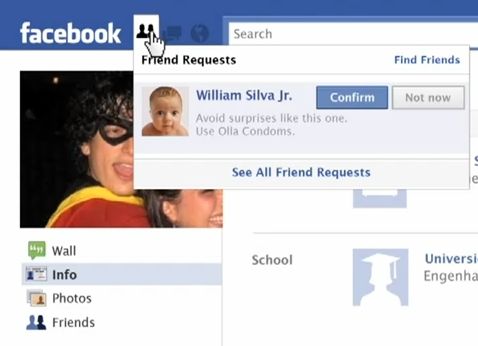
In a controversial effort to promote the use of condoms among young men, Age Isobar created a Facebook campaign which involved the creation of baby profiles that were then used to send friend requests to young men. The friend request came with the text, “Avoid surprises like this one. Use Olla Condoms.”

One one hand, this is an ingenious way to literally frighten young men into buying condoms. After all, if you’re not ready to have a child the notion of having one is pretty scary. On the other hand, some have taken issue with the campaign calling it a breach of Facebook’s TOS (babies aren’t 13 years old) and dubbing it spam.

Of the campaign, one commenter wrote, “Wow, you have officially brought social media advertising down to a whole new low. Not only is this campaign highly unethical, but it also violates Facebook’s TOS. The fact that you seem to be proud of this speaks volumes about your professional ethics and knowledge.”

Another who, in a way supports the approach, wrote, “it isn’t illegal, it’s TOS which has no weight behind it other then saying they can do X Y Z if you don’t abide by it, anyway kids are getting on this social networking junk all the time.”

So which is it? Brilliant marketing or rule-bending spam?

Picture of Steve Hall

Steve Hall

RECENT ARTICLES

TRENDING AROUND THE WEB

Studies on helicopter parenting link the behavior to parents’ own fear of danger and discomfort with separation, complicating the popular idea that constant helping is simply an extension of love

Studies on helicopter parenting link the behavior to parents’ own fear of danger and discomfort with separation, complicating the popular idea that constant helping is simply an extension of love

Global English Editing

A vocabulary that keeps quietly expanding well past someone’s twenties isn’t just a love of words — it’s the one measure of intelligence psychologists have trusted for a century because it tracks so closely with how a person actually thinks

A vocabulary that keeps quietly expanding well past someone’s twenties isn’t just a love of words — it’s the one measure of intelligence psychologists have trusted for a century because it tracks so closely with how a person actually thinks

Global English Editing

An Adobe survey found 69% of workers say emoji use makes a coworker seem more likable — and the reason has more to do with replacing missing body language than making a message friendlier

An Adobe survey found 69% of workers say emoji use makes a coworker seem more likable — and the reason has more to do with replacing missing body language than making a message friendlier

Global English Editing

A boundary delivered without an explanation usually isn’t coldness — it’s someone who’s learned that the explanation is exactly what invites the negotiation they were trying to avoid

A boundary delivered without an explanation usually isn’t coldness — it’s someone who’s learned that the explanation is exactly what invites the negotiation they were trying to avoid

Global English Editing

Someone who lets a frazzled stranger go ahead of them in line isn’t necessarily being generous — they’re picking up on small shifts in tone and posture that most people only catch when told to look for them

Someone who lets a frazzled stranger go ahead of them in line isn’t necessarily being generous — they’re picking up on small shifts in tone and posture that most people only catch when told to look for them

Global English Editing

The difference between the words you recognize and the words you actually use — and what that gap says about how you learned them

The difference between the words you recognize and the words you actually use — and what that gap says about how you learned them

Global English Editing