
British Airways Campaign Teaches British Slang

21794-queue.jpg

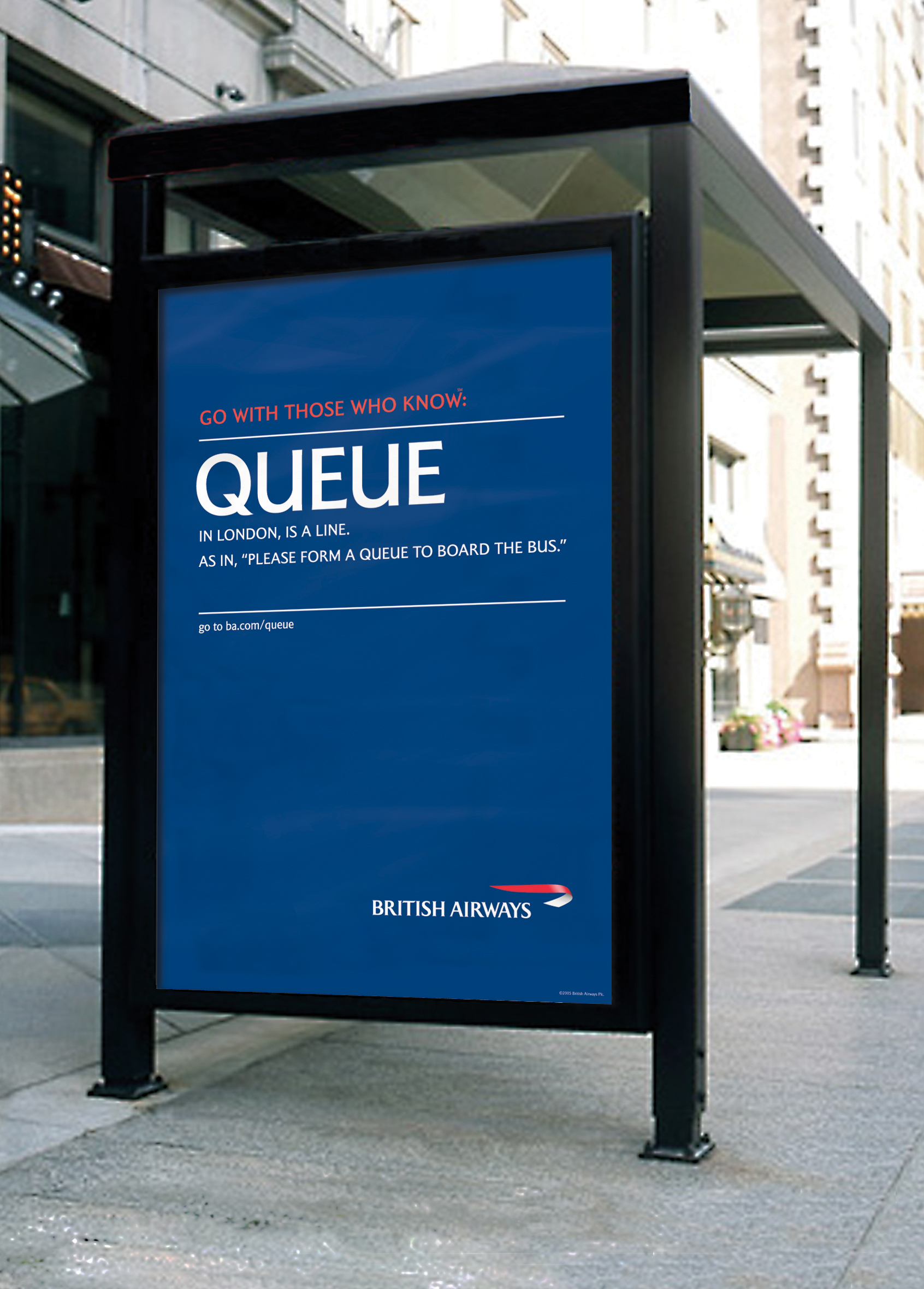
A new campaign for British Airways launched today in the New York area with outdoor ads containing British words such as Chuff, Cheers, Kip, Queue, Readies and others, each of which contains a URL that link to a word-specific microsite allowing the visitor to test their knowledge of British slang. All this is to clue in Americans before they hop on a British Airways flight to England for a vacation.

The New York City-area outdoor campaign – the airline’s largest – ever in North America – features over 60 different words that will be strategically placed near the object or idea the word defines. All the ads are done in British Airways blue and topped by the line “Go With Those Who Know,” first introduced in a British Airways leisure TV campaign in September 2004. In addition to wallscapes, phone kiosks and deli bags, the outdoor and out-of-home work will be found on highway billboards, postcards, bar coasters, menu boards, window posters and outdoor café umbrellas, again with fitting British words that “match” the occasion or the setting. Even London-style taxis will be wrapped with the creative work focusing on the legendary chattiness and service of the London cabbie. Images from the campaign can be viewed here.


Picture of Steve Hall

Steve Hall

RECENT ARTICLES

TRENDING AROUND THE WEB

Psychology says the happiest older couples aren’t the ones who “still have the spark,” they’re the ones who stopped performing romance and replaced it with something harder to name — a mutual willingness to be seen at their worst without either person reaching for the exit

Psychology says the happiest older couples aren’t the ones who “still have the spark,” they’re the ones who stopped performing romance and replaced it with something harder to name — a mutual willingness to be seen at their worst without either person reaching for the exit

Global English Editing

Psychology says people who are genuinely good listeners aren’t just being polite — they possess a rare form of emotional intelligence that most people mistake for passivity but is actually the opposite

Psychology says people who are genuinely good listeners aren’t just being polite — they possess a rare form of emotional intelligence that most people mistake for passivity but is actually the opposite

Global English Editing

I’m 37 and I just realized that every major decision I’ve made in my adult life was designed to avoid disappointing people who stopped thinking about me the moment I left the room – and that’s a lesson most people learn too late to rebuild

I’m 37 and I just realized that every major decision I’ve made in my adult life was designed to avoid disappointing people who stopped thinking about me the moment I left the room – and that’s a lesson most people learn too late to rebuild

Global English Editing

Psychologists say the clearest sign someone is unhappier than they realize isn’t sadness — it’s when they stop being able to feel joy in things that used to light them up, but they keep going through the motions anyway

Psychologists say the clearest sign someone is unhappier than they realize isn’t sadness — it’s when they stop being able to feel joy in things that used to light them up, but they keep going through the motions anyway

Global English Editing

The saddest sentence in the English language isn’t “I’m alone” — it’s “I’m used to it” spoken by someone over 65 with a full photo album, a family that calls on holidays, and a Sunday routine that looks from the outside like contentment but from the inside feels like a life that has been carefully organized around the assumption that no one is coming

The saddest sentence in the English language isn’t “I’m alone” — it’s “I’m used to it” spoken by someone over 65 with a full photo album, a family that calls on holidays, and a Sunday routine that looks from the outside like contentment but from the inside feels like a life that has been carefully organized around the assumption that no one is coming

Global English Editing

Psychology says people who educated themselves through curiosity instead of classrooms solve problems in a fundamentally different way that formal education can’t replicate

Psychology says people who educated themselves through curiosity instead of classrooms solve problems in a fundamentally different way that formal education can’t replicate

Global English Editing