Billboard Says Hot Dogs Are as Bad as Cigarettes

indy-hotdog.jpg

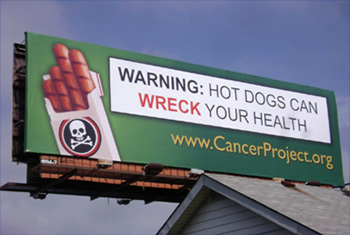
Anyone who doesn’t already know the ingredients of a hot dog consist mainly of the crap that falls on the floor after all the good stuff has been cut off the pig or the cow will find this new campaign informative. A billboard, located near the Indianapolis Motor Speedway, from the Cancer Project of the nonprofit Physicians Committee for Responsible Medicine reads, “Warning: Hot Dogs Can Wreck Your Health.” The headline is accompanied by an image of a cigarette pack filled with hot dogs.

The board was placed near the speedway because over 1.1 million hot dogs were served there during last year’s races.

Of the campaign, Physicians Committee for Responsible Medicine Education Director Susan Levin said, “A hot dog a day could send you to an early grave. Processed meats like hot dogs can increase your risk for diabetes, heart disease, and various types of cancer. Like cigarettes, hot dogs should come with a warning label that helps racing fans and other consumers understand the health risk.”

Think twice, people, before you devour that hot dog at your next cookout.

Picture of Steve Hall

Steve Hall

RECENT ARTICLES

TRENDING AROUND THE WEB

Psychologists say the bond between a person and the dog that sleeps in their bed isn’t comparable to human attachment. It’s actually more stable, because the dog never withdraws affection as punishment, never keeps score, and never makes closeness conditional on performance.

Psychologists say the bond between a person and the dog that sleeps in their bed isn’t comparable to human attachment. It’s actually more stable, because the dog never withdraws affection as punishment, never keeps score, and never makes closeness conditional on performance.

Global English Editing

The generation that performed stability even when they were barely holding on — boomers who kept immaculate homes, perfect lawns, and polished images while quietly falling apart — is finally putting down the mask, and this is what it looks like

The generation that performed stability even when they were barely holding on — boomers who kept immaculate homes, perfect lawns, and polished images while quietly falling apart — is finally putting down the mask, and this is what it looks like

Global English Editing

Psychology says adults with no close friends aren’t broken or antisocial — many of them simply learned early that the moment you show someone who you really are, that’s when they leave

Psychology says adults with no close friends aren’t broken or antisocial — many of them simply learned early that the moment you show someone who you really are, that’s when they leave

Global English Editing

Psychology says people who constantly try to become better versions of themselves aren’t actually growing — they’re running from a core belief that who they are right now isn’t enough, and that anxiety prevents the very self-acceptance that real growth requires

Psychology says people who constantly try to become better versions of themselves aren’t actually growing — they’re running from a core belief that who they are right now isn’t enough, and that anxiety prevents the very self-acceptance that real growth requires

Global English Editing

Research suggests that people who handwrite lists and people who use phone apps process their entire day differently. The paper list writers tend to plan from internal cues while the app users increasingly rely on external prompts, and over decades that difference quietly reshapes how autonomous a person feels inside their own life.

Research suggests that people who handwrite lists and people who use phone apps process their entire day differently. The paper list writers tend to plan from internal cues while the app users increasingly rely on external prompts, and over decades that difference quietly reshapes how autonomous a person feels inside their own life.

Global English Editing

Psychology says people who instinctively push their chair in when they leave a table aren’t just being polite – they grew up in households where someone always had to clean up after everyone else, and they never forgot what it felt like to be that person

Psychology says people who instinctively push their chair in when they leave a table aren’t just being polite – they grew up in households where someone always had to clean up after everyone else, and they never forgot what it felt like to be that person

Global English Editing