
Atlantic Asks the Tough Questions … But Oh, Where Are the Answers?

atlantic-evil-cool.jpg

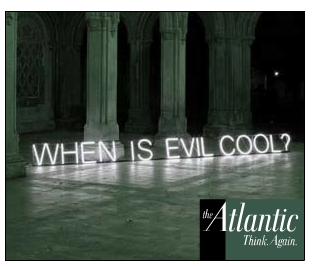
Operating under the premise that “there are too many rote answers and not enough good questions,” The Atlantic launched Think Again, for which rhetorical questions are posed in neon lights, foregrounding deserted industrial spaces.

Right now these ads are all over Internets. Videos, blog posts and photo variants are available on the site.

We like it — it’s a simple, but still eye-catching and occasionally even witty. Some we’ve seen:

o Should women settle?
o Why do presidents lie?
o Is the doughnut doomed?

Lately ad land is all about the rhetorical questions. (Maybe it’s the economy.) See Google’s T-Mobile G1 spot or those weire Ask.com pieces.

Speaking of Ask, it recently ran a banner ad campaign that posed questions, then invited people to click for the answer. The act brought them to Ask.com, where the answer appeared with a prominent heading and image.

That’s one tactic that would’ve made The Atlantic’s campaign better: if you could click on the banners and find news articles directly related to the question, maybe addressing it from multiple sides. As it is, the ads only bring you to the Think Again subsite.


Picture of Steve Hall

Steve Hall

RECENT ARTICLES

TRENDING AROUND THE WEB

I’m 42 and last week I caught myself saying ‘I’m so lucky’ about something I was clearly unhappy about and that’s when I realized I’ve been using gratitude as a way to gaslight myself for at least fifteen years

I’m 42 and last week I caught myself saying ‘I’m so lucky’ about something I was clearly unhappy about and that’s when I realized I’ve been using gratitude as a way to gaslight myself for at least fifteen years

Global English Editing

Psychology says adults who can’t sit still during phone conversations aren’t anxious — they learned early that their body language was the only part of communication they could fully control, and removing that channel creates a disorientation they have to physically compensate for

Psychology says adults who can’t sit still during phone conversations aren’t anxious — they learned early that their body language was the only part of communication they could fully control, and removing that channel creates a disorientation they have to physically compensate for

Global English Editing

The quietest people in most families are almost never quiet because they have nothing to say. They went quiet because they said something important once, it was dismissed or corrected, and they decided the cost of speaking wasn’t worth the possibility of being unheard again

The quietest people in most families are almost never quiet because they have nothing to say. They went quiet because they said something important once, it was dismissed or corrected, and they decided the cost of speaking wasn’t worth the possibility of being unheard again

Global English Editing

Psychology says the loneliest part of being an aging parent isn’t being alone – it’s realizing your children love you but don’t actually enjoy spending time with you, and understanding that gap is something you created decades ago

Psychology says the loneliest part of being an aging parent isn’t being alone – it’s realizing your children love you but don’t actually enjoy spending time with you, and understanding that gap is something you created decades ago

Global English Editing

Psychology says the freedom that childless couples experience in midlife carries a hidden cost. Without the natural structure that children impose on time, weekends, holidays, and decades, they must generate their own sense of purpose continuously, and that ongoing act of self-creation is both the privilege and the exhaustion nobody warns them about.

Psychology says the freedom that childless couples experience in midlife carries a hidden cost. Without the natural structure that children impose on time, weekends, holidays, and decades, they must generate their own sense of purpose continuously, and that ongoing act of self-creation is both the privilege and the exhaustion nobody warns them about.

Global English Editing

Psychology says staying silent in these 8 specific situations isn’t weakness or avoidance—it’s the most precise form of self-respect that most people only learn after saying the wrong thing one too many times

Psychology says staying silent in these 8 specific situations isn’t weakness or avoidance—it’s the most precise form of self-respect that most people only learn after saying the wrong thing one too many times

Global English Editing