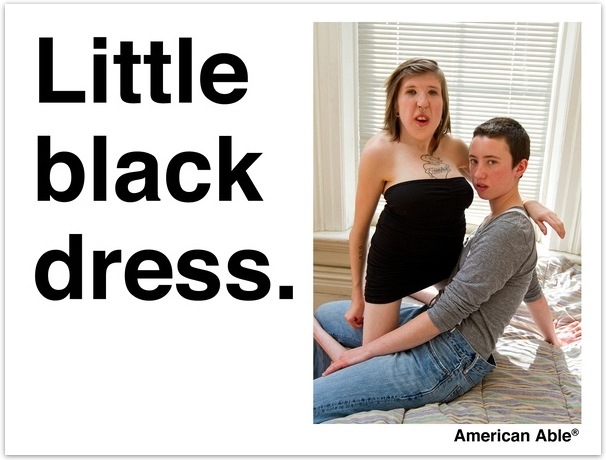
In an effort to challenge American Apparel’s assertion the people in their sexually charged ads are ordinary people, Trent University student Jes Sachse, who suffers from a genetic disorder called Freeman-Sheldon syndrome, will appear on posters in Toronto transit stations May 6, 11, 22 and 31.
Photographed by her friend Holly Norris for a series called American Able, Saches will dress and pose as if she were in an American Apparel ad. As Norris writes on her site, “American Able intends to, through spoof, reveal the ways in which women with disabilities are invisibilized in advertising and mass media.”
Of the series, Sache says, “I feel like my own sexual confidence is projected through, my own energy is projected through the photos. “I feel like I look confident in what I’m doing. I feel like I look like I believe that I belong there, in that context.”
And nailing the harm advertising can foist upon society, Norris says, “I had someone comment on it [the photo series], saying the work sort of has a shock value, and I think that’s an interesting comment, because it’s like . . . those are photos of Jes. Why does Jes’s body have a shock value? Why is it that people’s disabilities are so unseen that there’s a shock value there? There shouldn’t be.”
She’s right. But nothing will change. We will go on worshiping the fake, unattainable perfection we see in every form of media and heavily in advertising. We will go on worshiping the runway model, the busty, bikini-clad beer babe, the six-packed hottie in a Calvin Klein underwear ad, the movie star, the porn star, the teen starlet.
Yes, we will pay lip service to the objectification of women, the dumbing down of dads and the plight of minorities. But we will not give up our desire to stare at beautiful people instead of regular people, fantasize about a life more glamorous than our own and believe the products we buy will make us as hot as the people pimping them.
It’s sad. But it’s true.