Agency Ad Says Agencies Are Sweatshops

sweatshop_agency.jpg

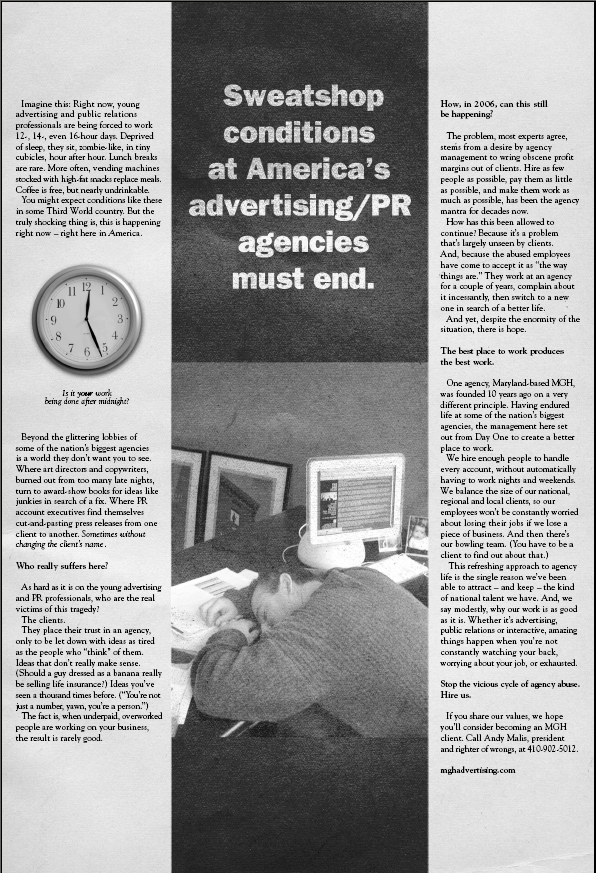
As a goof, a new business strategy and a statement that isn’t far from the truth, Maryland-based ad agency MGH placed an ad this week in the Wall Street Journal with the headline, “Sweatshop conditions at America’s advertising/PR agencies must end.” The ad claims agency personnel are overworked due to decades old practices of cutting overhead and under staffing, that it’s an unseen practice and that it negatively effects clients. All true. However, the ad neglects to mention clients no longer value most agencies as the true business partner they once were and refuse to pay them what they’re worth, sloughing them off and just another vendor which can be financially bled dry while the client reaps the rewards and profits the agency created for them. Of course, an ad that spoke that truth wouldn’t gain much new business.

To be fair, most agencies are not adapting to clients’ needs and have refused to step outside the mold that’s been in place for a hundred years. So it’s no surprise clients have devalued agencies because, in the eyes of the client, they aren’t getting what they want from the agency so they aren’t going to pay thereby causing the problem this ad so succinctly points out.


Picture of Steve Hall

Steve Hall

RECENT ARTICLES

TRENDING AROUND THE WEB

Studies on helicopter parenting link the behavior to parents’ own fear of danger and discomfort with separation, complicating the popular idea that constant helping is simply an extension of love

Studies on helicopter parenting link the behavior to parents’ own fear of danger and discomfort with separation, complicating the popular idea that constant helping is simply an extension of love

Global English Editing

A vocabulary that keeps quietly expanding well past someone’s twenties isn’t just a love of words — it’s the one measure of intelligence psychologists have trusted for a century because it tracks so closely with how a person actually thinks

A vocabulary that keeps quietly expanding well past someone’s twenties isn’t just a love of words — it’s the one measure of intelligence psychologists have trusted for a century because it tracks so closely with how a person actually thinks

Global English Editing

An Adobe survey found 69% of workers say emoji use makes a coworker seem more likable — and the reason has more to do with replacing missing body language than making a message friendlier

An Adobe survey found 69% of workers say emoji use makes a coworker seem more likable — and the reason has more to do with replacing missing body language than making a message friendlier

Global English Editing

A boundary delivered without an explanation usually isn’t coldness — it’s someone who’s learned that the explanation is exactly what invites the negotiation they were trying to avoid

A boundary delivered without an explanation usually isn’t coldness — it’s someone who’s learned that the explanation is exactly what invites the negotiation they were trying to avoid

Global English Editing

Someone who lets a frazzled stranger go ahead of them in line isn’t necessarily being generous — they’re picking up on small shifts in tone and posture that most people only catch when told to look for them

Someone who lets a frazzled stranger go ahead of them in line isn’t necessarily being generous — they’re picking up on small shifts in tone and posture that most people only catch when told to look for them

Global English Editing

The difference between the words you recognize and the words you actually use — and what that gap says about how you learned them

The difference between the words you recognize and the words you actually use — and what that gap says about how you learned them

Global English Editing