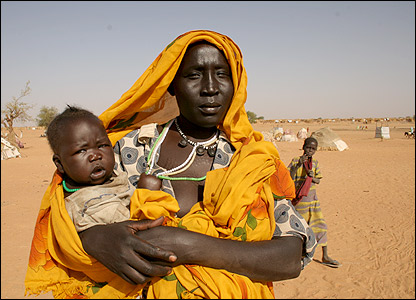
It bears mentioning that Panasonic Ideas for Life – Saving Darfur was as much about advertisers’ power to set global agendas as it was about the actual plight of Darfur. Call it a conceit, but there’s method to the madness.
Advertising played a pivotal role in raising awareness about genocide in Darfur. Some members of the panel expressed having been inspired into their current professions after seeing ads about famine or others’ suffering.
Early on in the panel, a member of the Save Darfur Coalition referred to driving “mass education” about genocide via “mass advertising.”
That sets the brain afire: do we want to take up the mantle of “educator”? If not or if so, what does that imply for ad firms that specialize in wrapping emotional experience around things?
Should we embrace social responsibility, or is this a slippery slope?
Policymaking is described as a supply and demand operation: there needs to be a demand, a citizen outcry, about injustices, in order to drive political change. Who better than advertisers to wield sentiment like a sword, eh?
A speaker described the marriage of marketing and movements thus: “One of the most important missing ingredients in the fight against genocide and famine and war in Africa is, strangely, marketing and advertising. Talk about strange bedfellows.” Indeed.
And Advertising Week’s Julie Thompson noted efforts like this “remind people of the good advertising and marketing can do; it’s not just about Super Bowl ads, it’s about moving people into action.”
That’s a warm, fuzzy takeaway.

Work for the Save Darfur Coalition was created by GMMB (an “issue agency”), which swelled the number of e-activists for the non-profit to over 1 million just last July.
David Mitchell of the Save Darfur Coalition shared some rules he discovered over the course of the campaign:
• People want to see evidence: dead bodies, masked raids, murders. Unfortunately, “Despots don’t call in the photographers when they’re about to execute mass numbers of people,” says Mitchell.
• You can’t make genocide ads that look like other ads about issues in Africa (like Save the Children ads, par exemple). People don’t pay attention to them.
• People want to know who the bad guy is. That’s not easy. Who do you blame? Investment houses? Omar al-Bashir? George-fucking-Bush?
• There are standards for taste and appropriateness: If you want something to appear in The New York Times, you can’t throw in the dead bodies people want to see. There are also specifications for Pan-Arabic publications regarding issues like rape and murder.
Campaign foci:
• Prior to the campaign, most people didn’t know what or where Darfur was. First-person accounts about rape, torture, murder, various horrors were used, and often read out loud by American suburbanites in the ad work, to make the issue more personal.
• Most muslims didn’t know this was muslim on muslim violence. Had to demonstrate this in a culturally sensitive way.
• Darfur was compared to Palestine, Lebanon – this struck the agency as off-center, but research indicated it would drive the point home.
• Divestment efforts – the campaign waged war against Fidelity, which ended up selling over 90 percent of its petro China interests.
In one campaign, satellite imagery was used to “show people a place that was otherwise an abstraction.” This effect was pretty awesome: “Google Earth” technology let users see “before attack” and “after attack” images of the grounds.
The session closed with words from Mira Sorvino, who made a few great points that rose like cream over a sea of emo.
The actress started working with Amnesty Int’l in March ’04 as a Stop Violence Against Women Goodwill Ambassador. The use of rape as a tool of war in Sudan affected her a great deal.
As a kid, she had nightmares of being a Jew in the Holocaust (Sorvino is Christian) – she blames Anne Frank for the fixation.

One thing that stuck out for me: In her elaborate fit of passion, she described wondering whether she would have been a brave enough Jewess to suicide-bomb Hitler.
I could imagine her PR guy going, “Oh fuck.”
But Sorvino’s testimony shed light on an interesting point: advertising has power, not merely to encourage children to admire movie stars and beautiful women, but to appeal to their sense of sympathy – and indignation – on injustice and human sufferings.
This can make a huge impact on what they choose to do with their lives.
Sorvino points out that if we can inflame people, veritably intoxicate them with an idea or a notion, why not use it to save Darfur?