
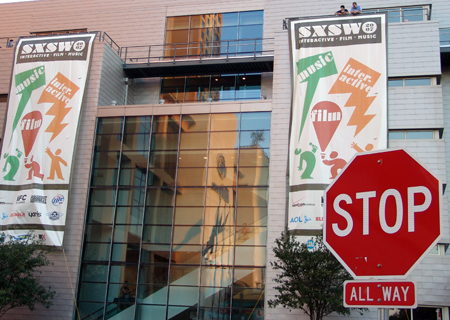
SXSW: Drunk at the Wheel, Driving Social Technology

SXSWIntersection.jpg

Offering no apologies for social disruption, the Emerging Social and Technology Trends panelists invite themselves into your conversation. The panel on Saturday hosted yet again a large group of speakers from diverse backgrounds. Although intimate panels tend to be more revealing, this one at least showed a little leg. Headed up by Laura Moorhead (Wired), the panelists included Andrew Blum (Wired), Robert Fabricant (Frog Design), Eliot Van Buskirk (Wired), Peter Rojas (Engadget), and Daniel Raffel (Yahoo!).

Perhaps drunk at the wheel sometimes, technology does drive social change. In turn, everyday people are now enabled to be the drivers as well. Similar to the blur of how you got home the night before, there is no longer a clear sobriety line to walk between social interaction and technology. Likewise, a constant negotiation between public and private, business and pleasure, leaves many at polar realms. Understanding the integration versus isolation debate is said to help us understand ourselves, or at least what Kool-aid we drank to get there.

Tagged as disruptive technology, the panel discussed various tools, techniques, and software that continue to evolve standards and transparency. Seemingly, the term transparency is no longer valid, as the opacity is continuing to be set at zero percent. Widgets, like the beginnings of the internet, take away a sense of geographical personas, while social “tools” like Twitter take away any remaining sense of privacy. “Twitter might be the breaking point,” said Peter Rojas, concerned about an inevitable backlash of technology. Explaining it similar to the subcultures that turned on CDs in favor of vinyl, Rojas believes that there will always be backlashes, but not necessarily mass rejections. “But we wouldn’t know about a backlash because they wouldn’t be blogging it, right?” Rojas joked to the crowd’s chuckle.

Though there’s an amplification of influence in self, it also penetrates brands and microbrands alike. Many brands are trying to drink the Kool-aid, letting the voice of the customer lead the way. While in no way is it a bad idea, Robert Fabricant explained that it gives a company power as well as a burden. The key, Fabricant explained, is how to interpret the learnings from the ongoing conversations, which is a responsibility strategists and planners face.

Asked the question about companies’ fear of their products being hacked, the panelists concurred that the vast majority of hacks help generate interest in a product rather than serve as a huge threat to success. An offered solution to help ease the pain was for companies to commit to “upgradability” as well as learn how to monetize consumer hacks. Pushing for augmentation over customization, it was apparent that there remains a friction point between consumers and brands. The iPhone came up as a perfect example, in that the potential of the device alone generated interest, however the excitement soon turned flacid once it revealed its closed platform nature. Soon after, the lack of faith in mobile carriers and the fight for consumer enablement took over the discussion. Despite many yielding through the intersection of social and technology, it may take a new generation to legalize an American autobahn.

Our SXSW photo album can be seen here.

Picture of Steve Hall

Steve Hall

RECENT ARTICLES

TRENDING AROUND THE WEB

Psychology says people who are genuinely good listeners aren’t just being polite — they possess a rare form of emotional intelligence that most people mistake for passivity but is actually the opposite

Psychology says people who are genuinely good listeners aren’t just being polite — they possess a rare form of emotional intelligence that most people mistake for passivity but is actually the opposite

Global English Editing

I’m 37 and I just realized that every major decision I’ve made in my adult life was designed to avoid disappointing people who stopped thinking about me the moment I left the room – and that’s a lesson most people learn too late to rebuild

I’m 37 and I just realized that every major decision I’ve made in my adult life was designed to avoid disappointing people who stopped thinking about me the moment I left the room – and that’s a lesson most people learn too late to rebuild

Global English Editing

Psychologists say the clearest sign someone is unhappier than they realize isn’t sadness — it’s when they stop being able to feel joy in things that used to light them up, but they keep going through the motions anyway

Psychologists say the clearest sign someone is unhappier than they realize isn’t sadness — it’s when they stop being able to feel joy in things that used to light them up, but they keep going through the motions anyway

Global English Editing

The saddest sentence in the English language isn’t “I’m alone” — it’s “I’m used to it” spoken by someone over 65 with a full photo album, a family that calls on holidays, and a Sunday routine that looks from the outside like contentment but from the inside feels like a life that has been carefully organized around the assumption that no one is coming

The saddest sentence in the English language isn’t “I’m alone” — it’s “I’m used to it” spoken by someone over 65 with a full photo album, a family that calls on holidays, and a Sunday routine that looks from the outside like contentment but from the inside feels like a life that has been carefully organized around the assumption that no one is coming

Global English Editing

Psychology says people who educated themselves through curiosity instead of classrooms solve problems in a fundamentally different way that formal education can’t replicate

Psychology says people who educated themselves through curiosity instead of classrooms solve problems in a fundamentally different way that formal education can’t replicate

Global English Editing

Psychology says the boomer men now entering their late 60s and 70s are carrying a specific kind of unhappiness that has almost no cultural language — they were raised to provide, protect and endure, and most of them did all three brilliantly, and the cruelest reward for a lifetime of quiet service is discovering that the role was the entire identity and without it there’s a man underneath who was never introduced to anyone including himself

Psychology says the boomer men now entering their late 60s and 70s are carrying a specific kind of unhappiness that has almost no cultural language — they were raised to provide, protect and endure, and most of them did all three brilliantly, and the cruelest reward for a lifetime of quiet service is discovering that the role was the entire identity and without it there’s a man underneath who was never introduced to anyone including himself

Global English Editing